
Low-Thickness External Insulation: How to Work on Facades and Complex Details Without Adding Too Much Thickness
Low-Thickness External Insulation: How to Work on Facades and Complex Details Without Adding Too Much Thickness
What you will discover in this article: when working on the building envelope, it is not always possible to install an external insulation system with significant thickness. Decorated facades, balconies, soffits, window reveals, terraces, existing buildings with architectural constraints, or simply construction details that are difficult to modify often make the installation of a traditional ETICS system more complicated. In these cases, low-thickness external insulation can become a practical solution for improving the thermal behavior of the surface without introducing dimensional increases that are difficult to manage. Among the available solutions, Manti Ceramic fits into this context as a nanotechnology-based proposal designed to work within just a few millimeters, even on the most delicate areas of the facade.
Eng. Elena Galeotti – 15/04/2026
Contents
- Why external insulation can become complicated
- When a low-thickness system is the right choice
- Where it can be applied externally
- What solutions Manti Ceramic offers
- Useful technical data
- FAQ
Why external insulation can become complicated
In theory, insulating a building externally is one of the most effective ways to improve comfort and reduce heat loss. In practice, however, the difficulty arises when the available thickness is limited or when increasing it would require major secondary modifications.
This issue frequently occurs on:
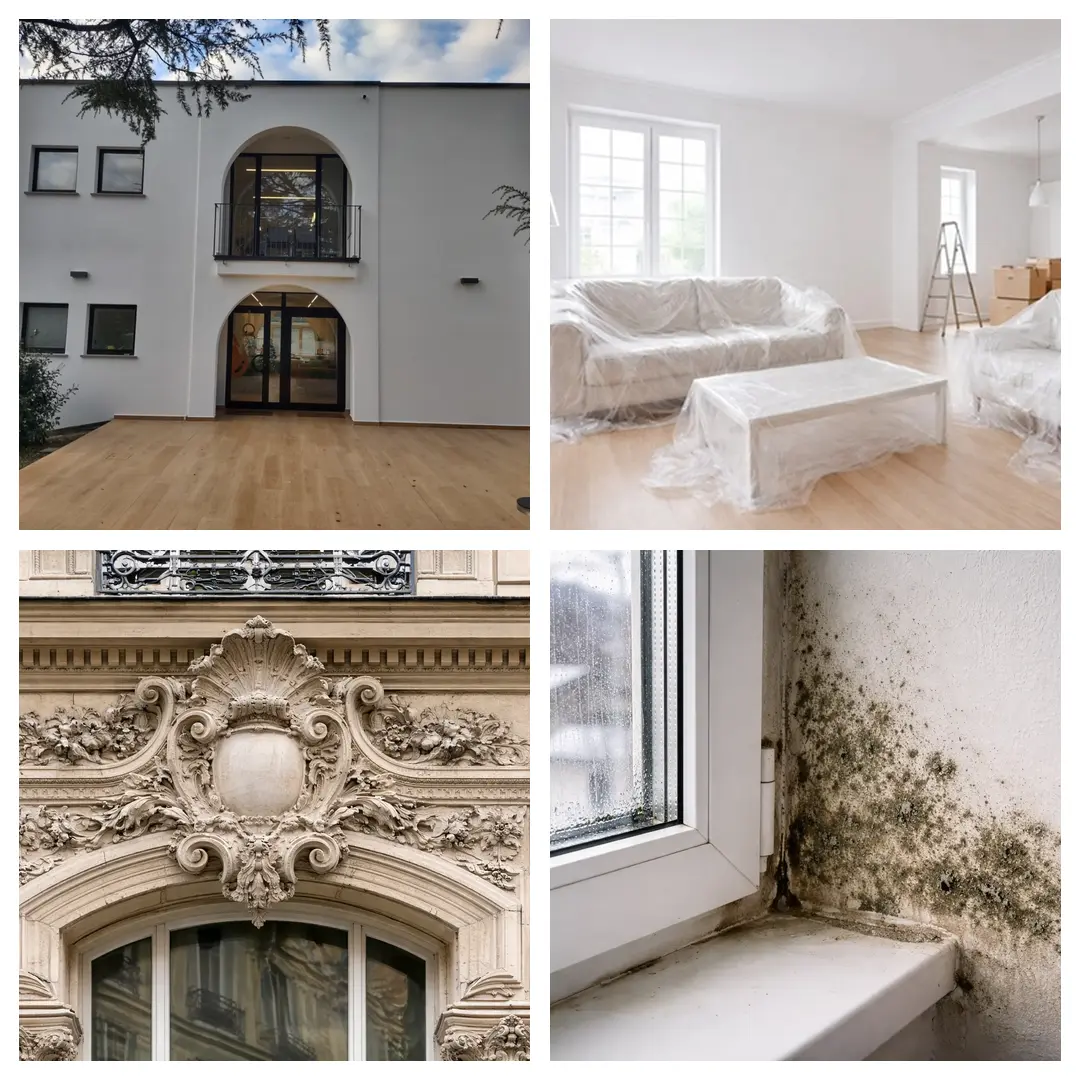
- facades with decorative elements and reliefs;
- existing buildings with aesthetic constraints;
- window reveals and jambs;
- balconies and balcony soffits;
- terraces;
- junctions with thresholds, window sills, and sheet metal details;
- critical points where every centimeter affects the entire construction detail.
In all these situations, adding many centimeters may also mean having to modify window frames, flashings, drip edges, overhangs, and finishes. For this reason, low-thickness external insulation is not a compromise solution, but a precise technical response to a real design constraint.
When it is worth choosing low-thickness external insulation
A thin external system is useful whenever a traditional insulation system is impractical or would require excessively invasive additional work.
It can be an interesting option when it is necessary to:
- insulate a facade without excessively altering its appearance;
- work on balconies or balcony soffits;
- correct external thermal bridges;
- work on window reveals and recesses;
- treat decorated surfaces;
- reduce the impact of secondary works;
- operate in contexts where every millimeter matters.
In these cases, the benefit is not only the reduced thickness itself, but also the possibility of carrying out a more manageable intervention from an application point of view.
Where it can be applied externally
When discussing low-thickness external insulation, this does not refer only to the main facade. Possible applications involve many parts of the building envelope that often remain critical precisely because they are difficult to treat with bulkier systems.
Possible external applications
- vertical facades;
- balconies;
- balcony soffits;
- terraces;
- window reveals;
- recesses;
- friezes and moldings;
- decorative surfaces;
- small exposed areas of stone or marble;
- points requiring thermal bridge correction.
This makes it possible to address not only the issue of the external wall as a whole, but also continuity in the details, which are often the most problematic parts.
Manti Ceramic for low-thickness external insulation
Among the solutions that can be considered in these contexts is Manti Ceramic, a range of nanotechnology-based insulating products designed for applications with reduced thickness.
One of the most interesting aspects is the availability of different versions depending on the type of substrate and intended use. This makes it possible to tailor the intervention according to the external context, the surface, and the construction detail to be treated.
Main advantages of Manti Ceramic for Low-Thickness External Insulation
Among the main points of interest are:
- low application thickness;
- possibility of use on complex external details;
- adaptability to masonry and decorative surfaces;
- usefulness in correcting thermal bridges;
- reduction of secondary works compared to thicker systems;
- fast installation;
- availability of dedicated formulations.
Useful versions for low-thickness external insulation
Manti Ceramic High Density
Paste version for internal and external masonry.
Main data:
- recommended thickness: 2–10 mm
- declared thermal conductivity: λd = 0.0010 W/mK (Test R 1995870)
- solar reflectance index: SRI 109.0
- fire reaction: Euroclass A2 s1 d0
- EPD certification
- 15-year warranty
It is suitable when there is a need to work on external masonry surfaces with application continuity and limited thickness.
Manti Ceramic Medium Density
Semi-liquid version suitable for very thin applications.
Main data:
- recommended thickness: 0.6–2 mm
- declared thermal conductivity: λd = 0.0010 W/mK (Test R 1995870)
- solar reflectance index: SRI 107.0
- fire reaction: Euroclass A2 s1 d0
- EPD certification
- 15-year warranty
It can be particularly useful on:
- window reveals;
- friezes;
- reliefs;
- architectural details;
- localized thermal bridge corrections.
Transparent Low Density
It is designed for exposed surfaces where the original appearance of the material must be preserved, such as stone, marble, or exposed brick. It is applied in microns.
Why low thickness can really help in external works
The advantage is not only technical, but also practical. On many external job sites, the real obstacle is not the intention to insulate, but the difficulty of managing everything that comes with increased thickness.
Working with just a few millimeters can help limit interventions on:
- window sills;
- thresholds;
- sheet metal details;
- junctions;
- jambs and reveals;
- decorative elements;
- projections and facade details.
For this reason, low-thickness external insulation can represent a useful design choice when the context does not allow for more invasive solutions.
FAQ
When is it worth choosing low-thickness external insulation?
When the facade or construction details do not allow for a significant increase in thickness, or when a traditional system would require too many secondary modifications.
Low-Thickness External Insulation is suitable only for flat facades?
No. It can also be considered for balconies, balcony soffits, window reveals, friezes, reliefs, and other complex external points.
Can it be useful for external thermal bridges?
Yes, especially in localized areas where continuity is needed without creating excessive thickness.
Which version is more suitable for external masonry?
In general, Manti Ceramic High Density is the indicated version for internal and external masonry.
Is there a solution for exposed external surfaces?
Yes, Transparent Low Density is designed for materials such as stone, marble, and exposed brick, when the aesthetic appearance must remain visible.
Are all low-thickness nanotechnology systems the same?
No. They differ in composition, intended use, workability, performance, and compatibility with different substrates. Manti Ceramic stands out for its high product quality, workability, and the availability of certifications carried out by accredited third-party bodies.
Conclusion
In refurbishment works, low-thickness external insulation can be a particularly useful solution when facades, balconies, window reveals, balcony soffits, or decorated surfaces do not allow interventions with many centimeters of thickness.
In this context, a range such as Manti Ceramic offers different application possibilities according to the substrate and the detail to be treated, helping make intervention possible even where a traditional ETICS system is more difficult to install.
For more information or for a consultation, you can write to info@manti-ceramic.com
To explore applications and practical case studies, you can visit our linkedin page https://www.linkedin.com/company/savenergy-it-srl-holding/


Leave a Reply
Want to join the discussion?Feel free to contribute!