NANOCOATING: mistakes to avoid when choosing a nanotechnological insulating system
The false myths of the nanocoating: mass, heat, and thermal lag
When it comes to innovative thermal insulation, nanocoating represents one of the most advanced technologies available on the market today. However, its use is often accompanied by theoretical and practical mistakes that compromise the expected results. In this article, we analyze the main misunderstandings, also relying on a certified thermographic report carried out in the province of Milan.
The main mistakes when approaching nanocoating
Mistake no. 1 – “Insulation depends on mass”
This is perhaps the most common one. The classic principle of thermal insulation is based on the idea that centimeters of material are needed to slow down heat transmission. But nanotechnology works differently: nanocoating blocks heat, it does not slow it down, thanks to reflection and the direct hindrance of thermal passage.
Mistake no. 2 – “It only works for heat”
On the contrary, a nanocoating works both in summer and winter. Its mechanism is bidirectional: it prevents heat from entering in the hot months and hinders its exit in the cold months.
Mistake no. 3 – “Thermal lag is needed”
The concept of thermal lag applies to traditional materials. A nanoinsulator does not accumulate heat; it repels it. Therefore, asking for thermal lag in a material such as Manti Ceramic is a misjudgment.
Mistake no. 4 – “Measuring effectiveness with heat fluxmetry”
Heat fluxmetry works well on massive materials but is inadequate for testing a nanocoating. This is because it works through reflection and not accumulation, and the results would be distorted.
The thermographic report: nanocoating Manti Ceramic vs traditional EPS
An official thermographic report, carried out on a building in the province of Milan, compared the 8 mm thick Manti Ceramic with a 12 cm graphite EPS coating. The result? An average surface temperature difference of less than 0.4 °C between the two solutions.
This data, seemingly minimal, is actually extraordinary: it means that 8 mm of nanocoating provide equivalent performance to 12 cm of graphite EPS with conductivity λ = 0.031 W/mK. By making a simple mathematical ratio (0.031 / 15), it is confirmed that the effective λ of Manti Ceramic is around 0.002 W/mK.
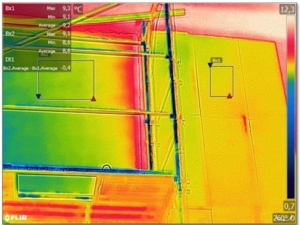
The image shows the thermography carried out during the report that compared the Manti Ceramic nanocoating with graphite EPS
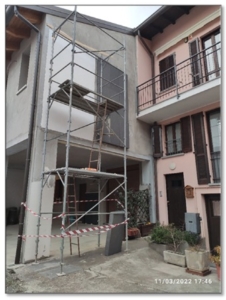
The wall on which 8 mm of Manti Ceramic nanocoating and 12 cm of graphite EPS were applied.
Why choose Manti Ceramic
Thanks to these performances, the Manti Ceramic nanocoating represents a concrete and certified alternative to traditional coatings. It insulates better, takes up less space, and does not require invasive works.
Those who wish to make conscious choices must therefore rely not only on technical data sheets but also on certified tests, real-life experiences, and – above all – the correct interpretation of the physical properties of nanotechnology.
Conclusions
Nanocoating is not an additive paint. It is a complex, scientifically validated system that requires expertise to be understood and valued. Those who make mistakes in assessing it risk excluding one of the most efficient and sustainable technologies for building insulation.
📩 For more information on this topic or to request our complete thermographic report, write to us at:
📧info@manti-ceramic.com
📺 Visit and subscribe our Linkedin page https://www.linkedin.com/company/savenergy-it-srl-holding/ to discover new videos about nanotechnological insulation in construction.