Traditional Insulation vs Nanoceramic Insulation: How They Work
Traditional insulation slows down heat – nanocoating Manti Ceramic reflects it
When we talk about thermal insulation, we often think only of thickness. However, insulation systems are based on very different physical principles. The nanocoating Manti Ceramic is not just a thinner solution — it’s a radical shift in how we manage heat flow.
The resistance principle: how traditional insulation works
Conventional insulation materials like EPS, XPS, rock wool, cork, or wood fiber work by thermal resistance. In essence, they do not stop heat, they slow it down, using their low conductivity (λ ≈ 0.031 – 0.040 W/mK).
To be effective, they require thicknesses from 8 to 16 cm, creating what’s known as thermal lag. While this may help in winter, in summer they accumulate heat during the day and release it in the evening – just when it’s least needed.
Moreover, traditional insulation:
- involves invasive construction (window and threshold modification, downpipe repositioning),
- fails to effectively fix thermal bridges,
- may suffer from cracks, detachments or hail damage.
Reflective barrier principle: the innovation behind nanocoating Manti Ceramic
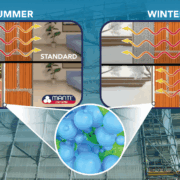
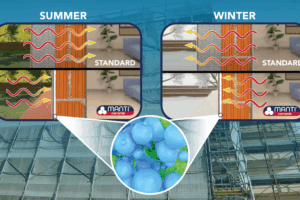
The nanocoating Manti Ceramic works completely differently: it creates a reflective thermal barrier. Rather than delaying heat, it blocks it thanks to:
- hollow ceramic microspheres that reflect up to 88% of infrared radiation;
- nanotech binders that block conduction and convection;
- air gaps inside the microspheres that interrupt heat flow.
👉 Result: high insulation performance with only 0.6 to 10 mm thickness, without structural changes.
Key features of nanocoating Manti Ceramic:
- Thermal conductivity λ: 0.001 – 0.002 W/mK (up to 30 times better than traditional materials)
- Certified reflectivity (SRI): up to 111, higher than even standard white reflective paints
- Application: on interior or exterior surfaces, no demolition required
🔄 A direct comparison
| Feature | Traditional insulation | Manti Ceramic |
| Operating principle | Thermal resistance | Reflectivity + ultra-low λ |
| Required thickness | 8–16 cm | 0.6 – 10 mm |
| Summer efficiency | Limited | High |
| Thermal bridge correction | Complex | Excellent |
| Application type | Invasive | Quick and clean |
| Durability | Low | Very high |
| Risk of detachment | High | Very low |
| Material | EPS, XPS, rock wool, etc. | Nanoceramic composite |
🌍 From aerospace to architecture: the power of nanotechnology
Nanocoating Manti Ceramic was born in aerospace, naval and industrial sectors. Today, it is rapidly gaining ground in building construction due to:
- extreme versatility,
- minimal thickness,
- no visual impact on surfaces,
- durability under mold, moisture and harsh weather,
- internationally certified performance (SRI, SR, fire class A2).
📩 Want to know more about nanocoating Manti Ceramic?
Write to us at info@manti-ceramic.com to request more details or a technical consultation.
🎥 Follow also our linkedin page: https://www.linkedin.com/company/savenergy-it-srl-holding/ you’ll find demos, case studies, and deep dives into nanotechnology-based building insulation.