London College of Foreign Trade: Nanotechnologies in Building Materials
Nanotechnologies in Building Materials: Benefits, Challenges, and Future Outlook
Source: London College of Foreign Trade
The use of nanotechnologies in building materials is revolutionizing the construction industry, offering innovative solutions in terms of performance, sustainability, and material durability. However, despite their numerous advantages, the use of nanomaterials in construction also presents significant challenges related to safety, costs, and regulations.
🏗️ Benefits of Nanomaterials in Construction
1. Improved Mechanical Properties
Materials such as carbon nanotubes, graphene, and nanocellulose can be incorporated into cement, concrete, and other construction compounds to increase their strength and durability.
Example: Adding carbon nanotubes to concrete can increase its compressive strength by up to 50%, making it ideal for bridges, tunnels, and skyscrapers.
2. Enhanced Thermal Insulation
Incorporating nanoparticles such as aerogels and nanoceramics into insulation panels significantly reduces heat transfer.
3. Increased Fire Resistance
Nanomaterials like nanoclays and nanophosphates improve the fire resistance of construction materials by slowing flame propagation and reducing smoke emissions.
Example: Using nanoclay in polymer composites decreases combustion rate and smoke generation, making them ideal for fire-prone environments.
4. Greater Durability and Longevity
Nanoparticles such as titanium dioxide and zinc oxide provide protection against environmental degradation, chemical attacks, and microbial growth, making surfaces self-cleaning and antimicrobial.
Example: Facades treated with TiO₂ nanoparticles stay clean longer thanks to photocatalysis, reducing maintenance costs.
5. More Sustainable Construction
Nanomaterials like nano-silica and nanocellulose help reduce the environmental footprint of building materials while also improving their recyclability.
Example: Concrete reinforced with nanocellulose fibers can cut carbon emissions by up to 30%, offering a more sustainable alternative to traditional concrete.
6. Improved Energy Efficiency in Buildings with nanotechnologies in building materials
Thanks to quantum dots and nanowires, nanotechnologies enhance the performance of solar panels, windows, and building envelopes.
Example: Incorporating quantum dots into solar panels allows them to convert a broader range of sunlight into electricity, boosting a building’s energy independence.
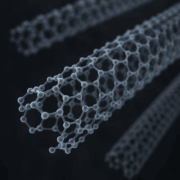
📷 Graphic representation of carbon nanotubes, one of the nanotechnologies used in building materials

⚠️ Challenges and Considerations of Nanomaterials in Construction
Despite their great potential, the use of nanomaterials involves:
-
Health and safety risks, especially for those who manufacture or install them;
-
Still-high costs, limiting large-scale adoption;
-
Complex regulations, related to nanoparticle exposure;
-
The need for standardization in production processes.
Example: It is essential to conduct thorough risk assessments, comply with regulatory exposure limits, and implement strict quality control to ensure the performance and safety of nanotechnology-enhanced materials.
🔬 Future Perspectives: Smart and Self-Healing Materials
Current research is focused on:
-
Multifunctional nanocomposites
-
Smart materials with self-healing capabilities
-
Nanosensors for real-time structural monitoring
Example: Materials are being developed that can autonomously repair cracks in concrete, extending infrastructure lifespan and reducing maintenance costs.
✅ Conclusion
Nanotechnologies represent a silent but powerful revolution in the construction industry. With their ability to improve mechanical properties, enhance energy efficiency, and promote sustainable building practices, nanomaterials are poised to become a key element of future construction.
Source: London College of Foreign Trade
📧 For more information about Manti Ceramic nanotechnology products, contact us at:
info@manti-ceramic.com
📺 Visit and follow our facebook page Thermal micro coating