
Historic facade insulation in Milan: low-thickness case history with raised cornices and stringcourses
Historic facade insulation in Milan: low-thickness case history with raised cornices and stringcourses
Overview: when work is required on a historic facade in a city-centre setting, insulation often calls for solutions other than traditional ETICS. In this Milan case history, the designer needed to improve thermal performance without significantly increasing thickness, occupying public land, or altering raised stringcourses and cornices. Therefore, the selected low-thickness solution combined 8 mm of Manti Ceramic High Density on the main external facades with 1 mm of Manti Ceramic Medium Density on the raised architectural details.
Quick index
- The design challenge in a historic urban setting
- Why a traditional ETICS system was not suitable
- The solution chosen for facades, stringcourses, and cornices
- Where low thickness simplified the project
- What this case history teaches
- Final FAQ
The design challenge in a historic urban setting
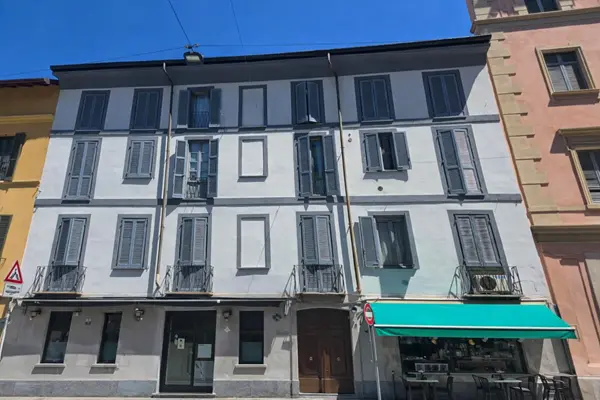
Historic facade of a residential building in Milan after an insulation intervention with Manti Ceramic products
The project involved a historic building located in a central area of Milan. Here, the designer was facing a very common situation in construction: improving the insulation of a historic facade without compromising the image of the building and without introducing overly invasive external work.
In this case, there were three main constraints.
- The first concerned the overall thickness of the insulation system. A traditional ETICS solution would have required additional centimeters on the facade, with consequences for projections, reveals, junctions, and scaffolding management.
- Secondly, the location of the building also played an important role, as it faced directly onto a central urban area. As a result, using a high-thickness insulation system could have created issues related to public land occupation, together with all the operational complications that typically arise in dense city-centre contexts.
- The third concerned the presence of raised stringcourses and cornices, elements that clearly define the appearance of the facade. In a historic facade insulation project, these details cannot be treated as simple flat surfaces. Instead, they require a material that can follow the reliefs while keeping thickness under control and avoiding the flattening of the original architectural design.
Why a traditional ETICS system was not suitable for insulating a historic facade
In buildings of this kind, a traditional ETICS system may be unsuitable not for theoretical reasons, but for very practical site and architectural compatibility reasons.
On historic facades with shaped elements, cornices, and stringcourses, high thicknesses can make junctions more complex and alter the visual reading of the moldings. In addition, when the facade faces directly onto the street or is located in central urban areas, every extra centimeter can have a practical impact on site organization.
For this reason, Savenergy.it offers solutions based on Manti Ceramic insulating layers for precisely those contexts where high-thickness panels cannot be applied. For example, this may happen on street-facing facades, period buildings with decorative reliefs and friezes, or buildings with limited space and architectural details that must be preserved.
The solution chosen for facades, stringcourses, and cornices
For this project, the selected solution was differentiated according to the surfaces to be treated.
On the main external facades, 8 mm Manti Ceramic High Density was specified. In particular, this version is suitable for both external and internal masonry surfaces and works well in projects where low-thickness insulation is required on large wall areas.
On the stringcourses and raised cornices, 1 mm Manti Ceramic Medium Density was used instead. More specifically, Medium Density is particularly useful when historic facade insulation must also cover decorative elements, friezes, and areas where thickness must be kept to a minimum. It is suitable for raised decorative features on period buildings, for thermal bridge correction, and as a finishing layer over High Density.
This combination made it possible to differentiate the system according to the geometry of the surfaces:
- Manti Ceramic High Density for the large, flat portions of the facade
- Manti Ceramic Medium Density for raised architectural details, where preserving the original visual profile was essential
Where low thickness simplified the project
The most interesting aspect of this case history is that low thickness was not just a product feature, but a true design criterion.
In practice, in a historic building located in a central area, reducing thickness often means simplifying several operational aspects:
- limiting the impact of the intervention on the external profile of the facade
- reducing critical issues at junctions with existing elements
- working more precisely on decorative areas
- limiting the need for heavy modifications to architectural details
- preserving the legibility of stringcourses and cornices
Therefore, for historic facade insulation, this approach is especially useful when the goal is not only to improve thermal performance, but also to maintain the aesthetic balance of the building envelope.
Another important aspect, moreover, is system continuity. Savenergy.it offers low-thickness products that can be used both on the main surfaces and on more delicate points, helping create a more coherent treatment of flat facade areas, reliefs, and construction joints where thermal bridges tend to be concentrated.
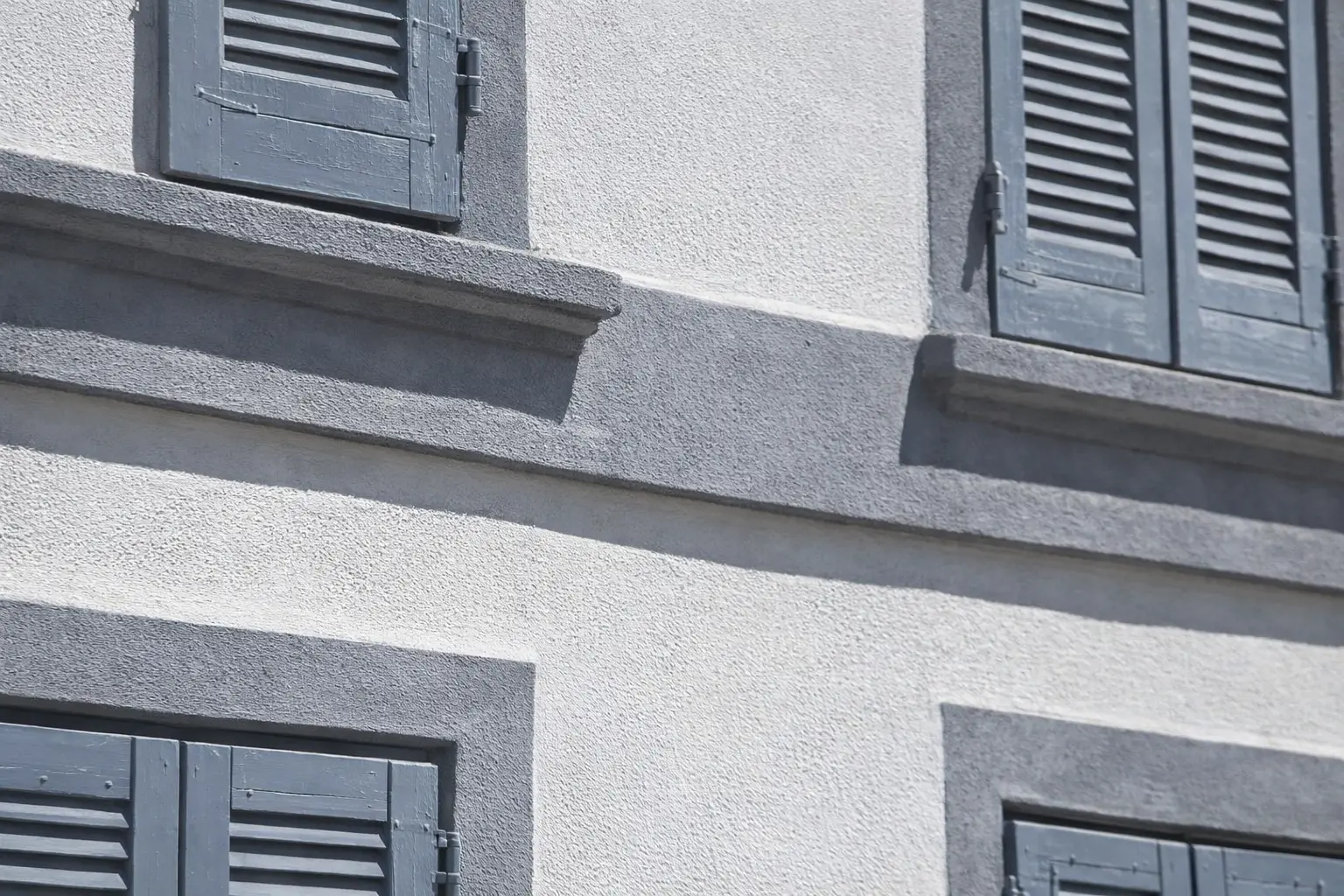
detail of cornices and tringcourses insulated with Manti Ceramic medium Density
What this case history teaches
This case history clearly shows that historic facade insulation does not always mean simply replacing a traditional ETICS system. On the contrary, in many historic or architecturally valuable buildings, the project must start from a balance between energy requirements, thickness limits, architectural details, and site practicality.
In the case of this Milan building, the choice of 8 mm High Density on the facades and 1 mm Medium Density on stringcourses and cornices made it possible to carry out an intervention consistent with the building’s architectural context.
Overall, this approach is particularly suitable when:
- the facade includes reliefs that must be preserved
- space is limited
- the building is located in a city centre or directly on the street
- the original appearance must not be altered
- the designer is looking for a low-thickness solution that can also be applied to complex geometries
Ultimately, in construction, the most delicate cases do not require only high-performance materials, but systems that truly adapt to the morphology of the building. When this happens, low thickness becomes a real technical advantage, not just a figure on a datasheet.
FAQ
When does historic facade insulation require low thickness?
It is especially useful when the facade faces directly onto the street, when aesthetic constraints are present, or when raised stringcourses, cornices, and friezes make the use of traditional insulation panels difficult.
Can cornices and stringcourses also be treated without altering them in a historic facade insulation project?
Yes. When thickness must be kept to a minimum, Manti Ceramic Medium Density is specifically suitable for raised elements and complex surfaces where it is important to preserve architectural legibility.
Why not use a traditional ETICS system on a historic building, or more generally on a facade where projecting onto public land is not possible?
It is not always the most suitable choice. In fact, high thicknesses can complicate junctions, architectural details, site management, and preservation of the original appearance.
What is the advantage of combining High Density and Medium Density?
It makes it possible to use a more structured thickness on the large facade surfaces and a minimal thickness on decorated or raised parts, thus ensuring greater design continuity.
For which buildings can this solution be suitable?
It can be suitable for historic buildings, architecturally valuable properties, apartment buildings in city centres, and facades with stringcourses, cornices, pilasters, and other architectural details requiring a minimally invasive intervention.
To assess a historic facade insulation project using low-thickness solutions, Savenergy.it is available for technical insights and case-by-case analysis. For information or consultancy, you can write to info@manti-ceramic.com.
To explore more applications and practical case studies, you can visit our LinkedIn https://www.linkedin.com/company/savenergy-it-srl-holding/
Eng. Elena Galeotti
April 15, 2026
