MANTI CERAMIC vs THERMAL PAINTS: The Real Low Thickness Thermal Insulation System
Why not all low thickness solutions are the same
In recent years, thermal insulation has rapidly evolved, introducing a wide variety of alternatives to traditional thick insulation systems. Among them, two technologies are often compared: thermal paints and the low thickness thermal insulation system offered by Manti Ceramic. Although they may look similar at first glance, the differences are substantial. Making the right choice can greatly affect performance, durability, and energy efficiency.
What is a real low thickness thermal insulation system?
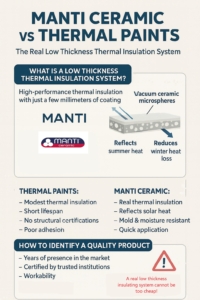
The phrase low thickness thermal insulation system refers to an advanced insulation solution that, thanks to nanotechnology, provides excellent thermal resistance using just a few millimeters of material. For example, Manti Ceramic combines patented vacuum ceramic microspheres with high-performance nanopolymer binders to form a true thermal barrier.
Its effectiveness relies not only on ultra-low thermal conductivity (λ = 0.0019 W/mK), but also on an extremely high Solar Reflectance Index (SRI > 100). This allows it to reflect summer heat and reduce winter heat loss, delivering year-round comfort and savings.
Thermal paints: what they are and why they fall short in comparison with a low thickness insulation system
Thermal paints are ultra-thin coatings — typically 0.5 to 1 mm thick — that contain a small percentage of ceramic microspheres. They can offer solar reflectivity, but they do not function as a true low thickness thermal insulation system.
Their key limitations include:
-
Limited thermal performance
-
Short lifespan
-
Lack of structural or safety certifications
-
Poor adhesion on various surfaces, leading to detachment and cracking over time
In most cases, these products behave more like enhanced decorative paints rather than reliable insulation solutions.
How to identify a quality low thickness insulation system
Because you can’t verify the internal quality of a nanotech insulation product with the naked eye or basic documentation, you must rely on objective indicators:
-
Years of market presence
-
Company certified by trusted institutions (e.g., TÜV, SGS) — a guarantee of reliability and manufacturing control
-
Workability: a good product should be easy to apply, smooth, compatible with standard tools, and resistant to peeling or blistering
-
Price per millimeter of thickness: a real low thickness thermal insulation system is never cheap
Manti Ceramic, a real performing low thickness insulation system: where real performance begins
Manti Ceramic is a certified low thickness thermal insulation system, applied in just a few millimeters and proven across more than 10,000 installations in Europe. Unlike thermal paints, it delivers:
-
Real insulation with extremely low λ values
-
High solar reflectance
-
Resistance to mold, humidity, and weathering
-
Fast application with no need for demolition or heavy structural work
Its product line includes solutions for façades, interiors, terraces, industrial surfaces, and even transparent coatings for historic buildings.
Conclusion: quality is not optional
Not all thin-layer systems are created equal. A cheap or uncertified product can put an entire renovation project at risk.
Choosing Manti Ceramic means trusting a proven, certified, and high-performance technology supported by a network of qualified professionals.
When it comes to a low thickness thermal insulation system, quality is not a luxury — it’s essential.
📩 Contact us!
To learn more about Manti Ceramic or other advanced insulation products, write us at info@manti-ceramic.com
Follow our linkedin page:
• application methods
• real benefits
• comparisons with traditional insulation materials