Hotel Thermal Insulation: The Benefits of Manti Ceramic Thermal Micro-Coating
Hotel Thermal Insulation: The Benefits of Manti Ceramic Thermal Micro-Coating
Hotel thermal insulation plays a key role in improving guest comfort, controlling energy consumption and protecting the long-term value of a hospitality property.
Today, architects, engineers and hotel owners are not simply looking for insulating materials. They need systems that can adapt to the characteristics of the building, provide continuity across the entire envelope and deliver high technical performance.
Manti Ceramic thermal micro-coating was developed to meet these requirements.
Thanks to its nanotechnology-based composition and its range of specialised formulations, Manti Ceramic can create a continuous insulating coating on walls, ceilings, thermal bridges, roofs and many other surfaces, while requiring only a limited build-up thickness.
The formulations developed for building applications are vapour-permeable, certified for anti-damp and anti-mould performance, rated Euroclass A2-s1,d0 for reaction to fire, and designed for both indoor and outdoor use.
Manti Ceramic provides thin, continuous hotel thermal insulation by adhering directly to compatible surfaces. Its different formulations can be combined to treat masonry, ceilings, thermal bridges, metal roofs and complex architectural details within the same project.
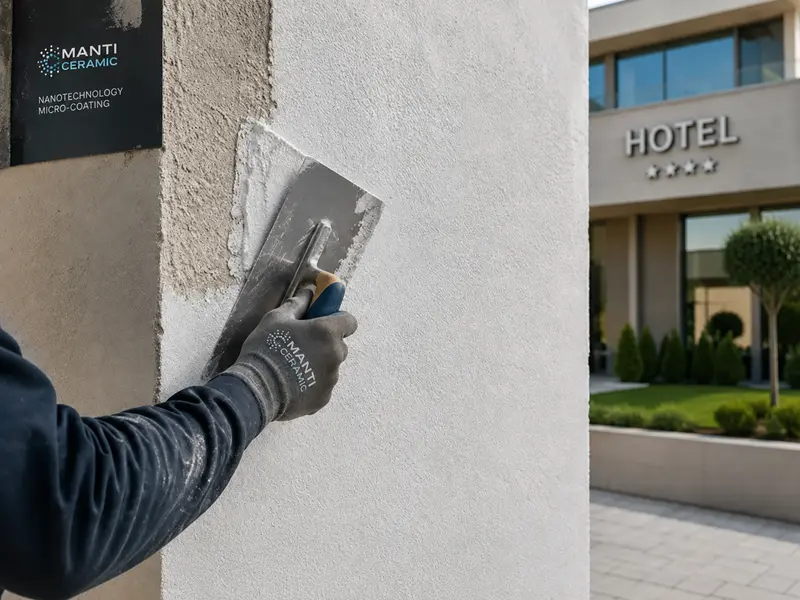
Application of Manti Ceramic micro-coating to improve hotel thermal insulation with a thin, continuous insulating layer.
Contents
- Why hotel thermal insulation is a strategic investment
- Why choose a thermal micro-coating for hotels
- The value of a continuous insulating coating
- The main characteristics of Manti Ceramic
- Which Manti Ceramic formulation should you choose?
- Where Manti Ceramic can be applied in hospitality buildings
- Why Manti Ceramic is a complete insulation technology
- Hotel thermal insulation FAQ
Why Hotel Thermal Insulation Is a Strategic Investment
The thermal insulation of a hotel is not only about reducing energy consumption.
In a hospitality building, the comfort perceived by guests also depends on surface temperatures, the absence of cold areas and the ability of the building envelope to limit heat loss throughout the year.
Walls, ceilings, columns, balconies and roofs form a single interconnected system. When every part of this system helps reduce heat flow towards the outside, heating and cooling systems can operate under more favourable conditions and indoor temperatures become more uniform.
For this reason, a hotel thermal insulation project should consider the building envelope as a whole rather than focusing only on individual surfaces.
Comfort Starts with the Building Envelope
Air temperature is not the only factor that influences guest comfort.
The temperature of internal surfaces also contributes to how comfortable a room feels. Cold walls, structural columns and thermal bridges can cause discomfort even when the HVAC system maintains the selected air temperature.
A higher-performing building envelope helps make internal surface temperatures more uniform and improves the quality of bedrooms, suites, reception areas and other spaces used by guests.
Why Choose a Thermal Micro-Coating for Hotel Thermal Insulation?
Every building has different construction characteristics. Hotel insulation systems must therefore be able to respond to a wide range of design requirements.
Manti Ceramic was developed as a nanotechnology-based insulation system capable of creating a continuous coating directly bonded to the substrate.
Unlike systems made from prefabricated insulating elements, Manti Ceramic is applied directly to the surface. It follows the existing shape, geometry, junctions and construction details of the building.
This makes it possible to create a continuous insulating envelope around elements such as:
- structural columns;
- lintels;
- balconies;
- niches;
- window reveals;
- curved surfaces;
- complex architectural details.
The result is a uniform surface that helps limit discontinuities in the building envelope and can adapt more easily to the different configurations commonly found in hotels and hospitality facilities.
The Value of a Continuous Insulating Coating
One of the distinguishing features of Manti Ceramic technology is its ability to create a continuous insulation layer.
Application continuity provides an important design advantage. The coating can closely follow the existing substrate without requiring shaped panels, specially cut components or complex adaptations around difficult details.
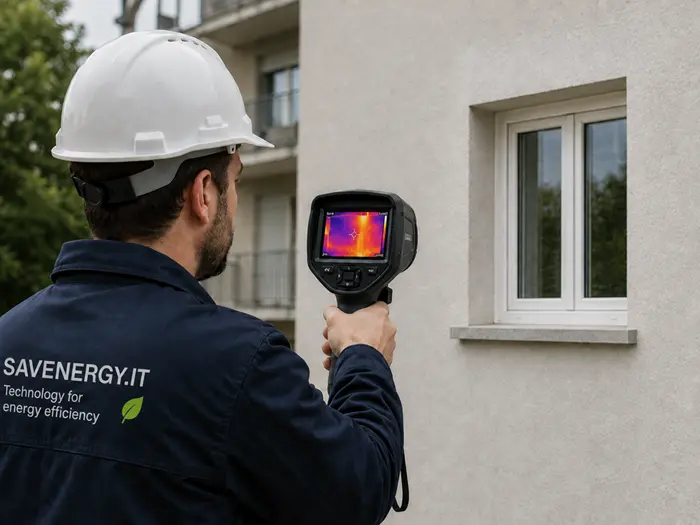
A thermal imaging survey helps identify heat loss and thermal bridges before a hotel thermal insulation project.
This characteristic is particularly relevant in hotels, where the building envelope often includes articulated architectural elements, surfaces with different geometries and numerous construction details.
The Manti Ceramic range has also been developed to provide several characteristics that are important in building applications:
- thermal insulation with limited thickness;
- high vapour permeability;
- certified anti-damp and anti-mould performance;
- Euroclass A2-s1,d0 reaction-to-fire classification for the relevant building formulations;
- low VOC content;
- strong adhesion to suitable substrates;
- suitability for both indoor and outdoor applications.
These characteristics make Manti Ceramic suitable for new-build projects as well as energy retrofit schemes in which improving the performance of the building envelope is a primary objective.
Hotel Thermal Insulation: Which Manti Ceramic Formulation Should You Choose?
A hotel insulation project cannot be completed with a single solution that is identical for every surface.
Different substrates often coexist within the same building, including masonry, structural columns, balconies, roofs, plant rooms, metal surfaces, decorative elements and complex architectural details.
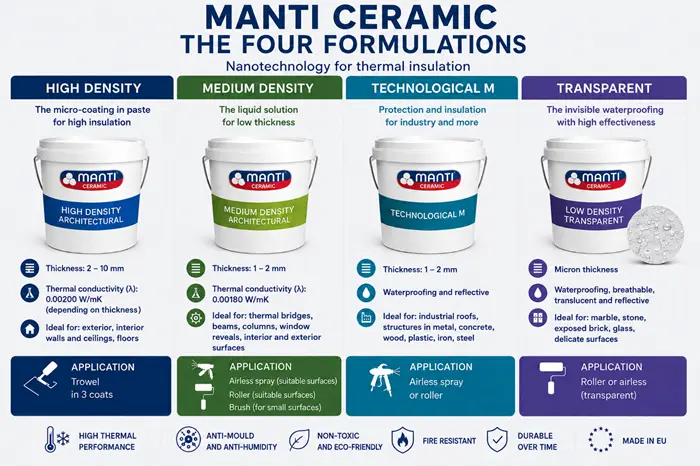
The four Manti Ceramic formulations provide hotel thermal insulation solutions for walls, thermal bridges, roofs, metal surfaces and architectural finishes.
Each of these areas may require different application and performance characteristics.
For this reason, the Manti Ceramic range includes several formulations developed for specific installation conditions and uses.
The choice does not depend only on the available thickness. It should also consider:
- the type and condition of the substrate;
- whether the application is internal or external;
- exposure to weather conditions;
- the geometry of the surface;
- the technical objectives of the project;
- the required final appearance.
Using Thermography to Identify Critical Areas
Thermographic analysis can help identify areas of the building where heat loss is concentrated.
These may include thermal bridges, columns, beams, window perimeters and other discontinuities in the building envelope.
This type of analysis supports more informed hotel thermal insulation planning by helping the technical team identify the surfaces that require priority treatment.
Suggested image caption: Thermographic analysis identifies the areas of a hotel where heat loss is concentrated, including thermal bridges, columns, beams and window surrounds.
Suggested image alt text: Thermographic survey identifying thermal bridges before a hotel thermal insulation project.
Manti Ceramic High Density
When the objective is to create continuous thermal insulation on walls and underfloor areas, Manti Ceramic High Density is the reference solution within the range.
It is a trowel-applied nanocomposite thermal insulation paste designed to create a continuous insulating layer with indicative thicknesses between 2 and 10 mm.
The product is vapour-permeable, certified for anti-damp and anti-mould performance, rated Euroclass A2-s1,d0 for reaction to fire, and characterised by a low VOC content.
In hospitality buildings, it can be applied to areas such as:
- external and internal perimeter walls;
- corridors;
- bedrooms and suites;
- reception areas;
- lounges and shared spaces;
- underfloor areas.
The continuity of the coating allows it to adapt to construction details within the building, helping create a more uniform insulating envelope.
Manti Ceramic Medium Density
For surfaces that require an even thinner application, the recommended solution is Manti Ceramic Medium Density.
This liquid nanocomposite thermal insulation product can be applied by Airless spray or roller. It has been developed for internal and external vertical and horizontal surfaces.
The formulation is particularly suitable for areas where every available millimetre is important to the design.
In hotel thermal insulation projects, it is frequently used on:
- thermal bridges;
- columns;
- beams;
- balconies;
- ceilings;
- window reveals;
- decorative elements;
- architectural mouldings and details.
Manti Ceramic Medium Density can also be used as a finishing layer over Manti Ceramic High Density, maintaining continuity across the insulation system.
Manti Ceramic Technological M
Hotels often include surfaces other than conventional masonry.
Metal roofs, plant rooms, building services and steel structures require materials with specific application and performance characteristics.
Manti Ceramic Technological M was developed for these contexts. It is a formulation designed for use on metal, concrete, wood and other compatible substrates.
The product combines thermal insulation with waterproofing properties, making it particularly suitable for roofs and surfaces exposed to weather conditions.
Typical applications include:
- metal roofs;
- technical plant rooms;
- mechanical and service rooms;
- steel structures;
- canopies;
- covered external structures.
Transparent Low Density
In some hospitality properties, preserving the original appearance of the surfaces is essential.
This may be the case in historic hotels, listed or prestigious buildings, or interiors characterised by natural stone, exposed brickwork and decorative finishes.
For these applications, the range includes Manti Ceramic Transparenti Low Density.
This formulation is designed for surfaces where maximum visual discretion is required, helping preserve the existing aesthetic appearance of the substrate.
A Product Range Designed to Work Together
One of the main advantages of Manti Ceramic technology is that the different formulations are not intended to be mutually exclusive alternatives.
They were developed to work together within the same insulation project.
For example, a hotel thermal insulation specification may include:
- Manti Ceramic Hign Density on the main walls;
- Manti Ceramic Medium Density on complex surfaces and construction details;
- Manti Ceramic Technological M on metal roofs;
- Manti Ceramic Bassa Transparent Low Density on architectural elements whose appearance must be preserved.
This approach makes it possible to treat the entire building envelope using a family of products developed according to the same technological philosophy.
The formulation can therefore be selected according to the substrate without compromising the overall continuity of the project.
Where Can Manti Ceramic Be Applied in Hospitality Buildings?
The thermal insulation of a hotel involves much more than its external walls.
Every surface separating conditioned indoor spaces from unconditioned areas or the external environment contributes to the building’s overall energy behaviour.
Manti Ceramic can therefore be used in numerous areas of a hospitality property, including:
- bedrooms and suites;
- corridors;
- reception areas and entrance halls;
- breakfast rooms and restaurants;
- wellness centres and spas;
- conference rooms;
- stairwells;
- ceilings;
- balconies;
- columns and beams;
- technical rooms;
- roofs;
- metal surfaces;
- thermal bridges.
The ability to work on different types of substrate makes the system particularly versatile in hotel renovation and energy retrofit projects.
Hospitality buildings often contain different materials, construction systems and surface conditions within the same property. The availability of several compatible formulations allows the technical solution to be adapted to each individual area.
Why Manti Ceramic Is a Technology, Not Just a Single Product
Manti Ceramic thermal micro-coating was developed from a specific approach to building insulation.
It is not a single formulation intended for every application. It is a range of nanotechnology-based systems designed to respond to the different requirements of contemporary construction.
The ability to create a continuous, vapour-permeable insulation layer, together with certified anti-damp and anti-mould performance and a Euroclass A2-s1,d0 reaction-to-fire rating for the relevant civil-building formulations, makes Manti Ceramic suitable for both new construction and energy retrofit projects.
Every building has different characteristics. The selection of the most appropriate formulation should therefore begin with an assessment of:
- the existing substrate;
- the required performance;
- the available application thickness;
- the environmental conditions;
- the objectives of the project.
Hotel Thermal Insulation FAQ
Which Manti Ceramic formulation is most suitable for hotel walls?
The choice depends on the characteristics of the project.
In general, Manti Ceramic Alta Densità is suitable for creating a continuous insulating layer on masonry walls. Manti Ceramic Media Densità is suitable for surfaces requiring a thinner application or for complex construction details.
The final specification should always consider the substrate, application conditions and required performance.
Can Manti Ceramic be used inside hotel bedrooms?
Yes. The formulations intended for civil-building applications can also be used on internal surfaces, provided that the application procedures described in the relevant technical manuals are followed.
Can different Manti Ceramic products be used in the same project?
Yes. The Manti Ceramic range was specifically developed to allow different formulations to be combined according to the substrate and the characteristics of each surface.
For example, Alta Densità can be used on the main walls, Media Densità on thermal bridges and complex details, and Technological M on metal roofing.
Can Manti Ceramic be applied to hotel thermal bridges?
Yes. Manti Ceramic Media Densità is frequently used on thermal bridges, structural columns, beams, window reveals, balconies and other areas where geometric complexity or limited available thickness makes conventional systems more difficult to install.
Is Manti Ceramic suitable only for hotels?
No. The same technologies can also be used in residential, commercial, industrial and historic buildings whenever continuous, low-thickness thermal insulation is required.
Can Manti Ceramic be used for both new-build and renovation projects?
Yes. The technology can be used in new construction as well as energy retrofit and refurbishment projects, subject to an assessment of the substrate, required performance and correct application procedure.
Conclusion
Modern hotel thermal insulation requires an approach that considers the energy performance of the building, guest comfort and the construction characteristics of the property.
Manti Ceramic technology was developed to respond to these requirements through a range of nanotechnology-based thermal micro-coatings capable of creating a continuous insulating layer on different surfaces and substrates.
The available formulations make it possible to treat:
- walls;
- ceilings;
- thermal bridges;
- roofs;
- metal surfaces;
- complex architectural elements.
Vapour permeability, certified anti-damp and anti-mould performance, a Euroclass A2-s1,d0 reaction-to-fire classification for the relevant civil-building formulations, and the possibility of working with limited thicknesses make Manti Ceramic suitable for both new buildings and energy retrofit projects.
Every hotel has its own technical requirements and should be assessed individually. The first step is therefore to analyse the building, identify the critical surfaces and select the Manti Ceramic formulation that best matches the substrate and the objectives of the project.
Contact Savenergy.it, the official distributor of Manti Ceramic
To discuss a hotel thermal insulation project using Manti Ceramic thermal micro-coating, the Savenergy.it technical team is available to provide information about:
- product characteristics;
- application procedures;
- substrate requirements;
- the most appropriate formulation for the project.
Email: info@savenergy.it
Website: www.manticeramic.it/en