Tag Archive for: manti ceramic
DoP for nanotechnology insulation: the Declaration of Performance of Manti Ceramic products
/0 Comments/in News/by Elena GaleottiDoP for nanotechnology insulation: the Declaration of Performance of Manti Ceramic products
Initial summary
The DoP for nanotechnology insulation is a key topic when a designer, contractor or site management team evaluates a Manti Ceramic thermal micro-coating. The point is not to provide a general explanation of the Declaration of Performance, but to understand how to use the available technical documentation to choose the right product, match it with the correct substrate and include it in a coherent building intervention.
Manti Ceramic is not a single generic material: it is a range of low-thickness solutions with different uses, to be read together with technical data sheets, test reports, application manuals and performance documentation available for the specific version.
The DoP, Declaration of Performance, is the document that accompanies construction products subject to CE marking and reports the performance declared by the manufacturer. In the case of Manti Ceramic nanotechnology insulation products, it helps designers, contractors and site managers verify performance characteristics, technical documentation and the correct framework of the application cycle. The documents can be downloaded from the website.
Synthetic index – DoP for nanotechnology insulation
- Why discuss the DoP when choosing Manti Ceramic
- The technical point: documentation, product and application must match
- Manti Ceramic: documents and selection criteria for each version
- Where documentation really affects the project
- Mistakes to avoid with nanotechnology insulation and DoP
- FAQ
Why discuss the DoP when choosing nanotechnology insulation
In the market for low-thickness nanotechnology insulation, technical documentation is one of the few objective elements that can help distinguish a product actually designed for the construction sector from a generic coating with performance claims that are difficult to verify.
For this reason, the DoP for nanotechnology insulation — correctly referred to as DoPC under the new European Regulation 3110/2024 — should be considered, when required and available for the specific product, together with the complete technical file.
In the case of Manti Ceramic, the point is not to state generically that “a certification exists”, but to verify which data are available for the selected version, which thickness they refer to and which application they can be used for.
For professionals and contractors, this is a practical step: it helps determine whether the product is suitable for an internal wall, a façade, a thermal bridge, a historic surface, a metal roof or an industrial substrate. Documentation does not replace technical assessment, but it allows that assessment to be carried out on more solid grounds.
Manti Ceramic High Density Data Sheet 
The technical point: technical documentation, DoP, product and application must match
With nanotechnology insulation, performance data should not be read separately from the application context. A thermal conductivity value, an SRI index, a reaction-to-fire class or a permeability value is useful only if it is connected to the correct product, the specified thickness and the indicated application cycle.
For Manti Ceramic, this is especially important because the range includes different formulations. A paste version for masonry does not have the same use as a semi-liquid version for thermal bridges or a technical product for sheet metal and roofs. The documentation must therefore be checked against the version actually used on site.
A correct reading starts with a few technical questions:
- which Manti Ceramic product is specified?
- which thickness is indicated in the project?
- on which substrate will it be applied?
- is the performance value consistent with that thickness?
- is the application cycle indicated in the manual compatible with the site conditions?
- is the available documentation sufficient for the intended use?
This is the practical relationship between DoP for nanotechnology insulation and Manti Ceramic: not an abstract regulatory reference, but a consistency check between product, declared performance and real application.
Manti Ceramic: documents and selection criteria for each version
Manti Ceramic is suitable for low-thickness nanotechnology insulation interventions on residential buildings, external surfaces, architectural details and indoor environments.
Savenergy.it offers Manti Ceramic as a range of low-thickness nanotechnology insulation products for residential and commercial construction, complex surfaces and technical applications. The version must be selected before assessing the documentation, because each product has a specific field of use. In addition, the DoP for Manti Ceramic nanotechnology insulation can be downloaded from the website.
Manti Ceramic High Density
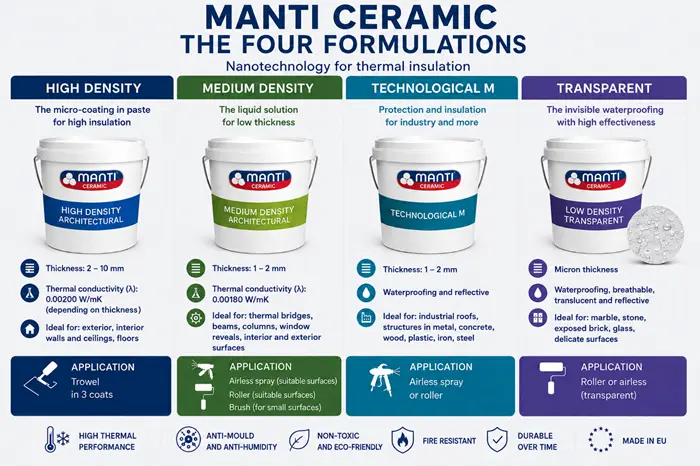
Manti Ceramic High Density is the paste solution indicated for internal and external masonry, vertical walls and interventions where a greater thickness is required compared to the more liquid versions.
It is suitable when the project requires a thermal micro-coating on a masonry substrate, with an application cycle similar to a technical skim coat. In this case, the documentation must be read in relation to thickness, build-up, finish and substrate preparation.
Thermal conductivity: λd = 0.0010 W/mK, certified by TÜV – Test R 1995870. See the second page of the technical data sheet for technical recommendations on applied thermal calculations for Manti Ceramic High Density.
Manti Ceramic Medium Density
Manti Ceramic Medium Density is a semi-liquid version indicated for thin applications, thermal bridges, mouldings, architectural reliefs, ceilings and complex geometries.
It is useful when roller or spray application makes it possible to treat difficult surfaces or details that could not be addressed with traditional panels. Here, the documentation check mainly concerns reduced thickness, continuity of the coating film, substrate and application conditions.
Thermal conductivity: λd = 0.0010 W/mK, certified by TÜV – Test R1274851-2.
Low Density Transparent
Low Density Transparent is indicated for surfaces where the original appearance of the material needs to be maintained, such as stone, marble, exposed brick or architectural details.
It may be considered for small visible thermal bridges when an opaque product is not compatible with the aesthetic requirement. In this case, the technician must also consider the porosity of the substrate and the final aesthetic result.
Manti Ceramic Technological M
Manti Ceramic Technological M is designed for technical and industrial surfaces: roofs, sheet metal, wood, plastic, cement, containers, cells, systems and surfaces where low-thickness thermal insulation and waterproofing are required.
The documentation must be checked in relation to the non-masonry substrate, exposure, substrate preparation and the intended application method.
The DoP, when required for the specific product, should therefore not be treated as an isolated document, but connected to the Manti Ceramic version actually selected and to the other available technical documents.

Manti Ceramic is suitable for low-thickness nanotechnology insulation interventions on façades, residential buildings, complex surfaces and indoor environments.
Where documentation really affects the project
The link between Manti Ceramic and technical documentation becomes decisive mainly in four situations.
Low-thickness energy retrofit. The designer must understand which data to use in calculations and whether they are consistent with the thickness that can actually be applied.
Correction of thermal bridges. The contractor must be able to follow a clear application cycle, because the result depends on the continuity of the treatment and its connection with adjacent surfaces.
Protected façades or complex surfaces. Documentation helps justify the choice of a low-thickness solution when traditional external insulation is invasive or cannot be applied.
Industrial or non-traditional substrates. For roofs, sheet metal, plastics, wood or containers, it is not enough to reason as if working on civil masonry: specific indications are needed for adhesion, substrate preparation, application and protection of the system.
In all these cases, technical documentation, including the DoP for Manti Ceramic nanotechnology insulation, helps professionals and contractors choose the correct version, avoid improper comparisons and reduce the risk of inconsistent applications.
FAQ
Is there only one DoP for all Manti Ceramic nanotechnology insulation products?
No. Documentation must always be checked for the specific Manti Ceramic version selected and for its related field of use. It is not correct to treat the range as if it were a single product. There is a DoP for each product in the range.
Is the DoP for nanotechnology insulation always mandatory and must it be published?
According to European Regulation 3110/2024, the DoP is mandatory and must be published. The DoPs for Manti Ceramic products are published on the manufacturer’s website and on the websites of the distributor Savenergy.it Srl.
Which Manti Ceramic should be assessed for internal and external masonry?
Manti Ceramic High Density is indicated for internal and external masonry when low-thickness paste insulation is required.
Which Manti Ceramic should be assessed for thermal bridges and complex geometries?
Manti Ceramic Medium Density is indicated for thermal bridges, mouldings, ceilings and difficult surfaces. Low Density Transparent may be considered for small visible details.
Does Technological M fall under the same assessment as civil masonry?
No. Technological M is mainly designed for technical and industrial surfaces. It must be assessed in relation to substrates such as sheet metal, roofs, plastics, wood, cement, containers and systems.
What should a technician ask before specifying Manti Ceramic in a project?
The technician should identify the correct version, the specified thickness, the substrate, the application cycle and the documentation available for that specific use.
Conclusion – DoP for nanotechnology insulation
The DoP for Manti Ceramic should not be read as a simple commercial data sheet, but as a technical document declaring performances, characteristics and references useful for the correct assessment of the product in the construction sector.
To assess the available technical documentation and identify the most suitable Manti Ceramic version for a building intervention, thermal bridge correction or low-thickness energy retrofit, it is possible to contact Savenergy.it at info@manti-ceramic.com.
Savenergy.it provides technical support for professionals and contractors on products, fields of use, substrate preparation, correct application and documentation available for the specific project.
To explore more applications and practical case studies, you can visit our LinkedIn https://www.linkedin.com/company/savenergy-it-srl-holding/
Ing. Elena Galeotti
13 May 2026
Manti Ceramic and EPD: how to evaluate a low-thickness nanotechnology insulation with environmental product documentation
/0 Comments/in News/by Elena GaleottiManti Ceramic and EPD: how to evaluate a low-thickness nanotechnology insulation with environmental product documentation
Summary
Manti Ceramic and EPD is a useful topic for designers, construction companies and technical professionals who need to evaluate thermal insulation solutions supported by environmental product documentation. An EPD, or Environmental Product Declaration, provides structured information on the environmental performance of a product throughout its life cycle, according to defined assessment rules and methods.
In construction, this type of documentation can be relevant for public and private projects, energy retrofits, building certifications and technical specifications requiring verifiable environmental data. Manti Ceramic is a low-thickness nanotechnology solution suitable for improving the thermal insulation of walls, ceilings, façades, thermal bridges and complex surfaces, with a less invasive application compared to traditional high-thickness systems.
Synthetic index
- What EPD means for construction products
- Why EPD is useful when evaluating thermal insulation
- How to connect Manti Ceramic and EPD to a specific project
- Which technical performances should support environmental documentation
- Where Manti Ceramic can be suitable in construction
- Common mistakes to avoid when choosing insulation with EPD
- FAQ
- Conclusion
What EPD means for construction products: Manti Ceramic and EPD
An EPD, or Environmental Product Declaration, is a document that communicates quantified environmental information about a product. In the construction sector, it allows materials to be assessed and compared on a more technical basis, within the conditions, categories and calculation rules that apply to each product type.
Speaking about Manti Ceramic and EPD means considering the product not only as a low-thickness thermal insulation solution, but also as a material supported by documentation that can be useful in projects requiring verifiable environmental data.
An EPD does not replace the technical evaluation of the product. However, it can help designers and technical professionals integrate environmental information into reports, specifications, building certifications or comparative assessments.
In construction, the choice of an insulation material should consider several factors: thermal performance, compatibility with the substrate, available thickness, durability, moisture behaviour, fire reaction, application conditions and available documentation. EPD adds a further level of information, especially when the project requires documentary traceability.
Why EPD is useful when evaluating thermal insulation
In a thermal insulation project, the main objective is usually to improve the energy performance of the building and indoor comfort. However, many current projects also require information about the environmental impact of the materials used. In this context, EPD can be useful because it provides organised and verifiable data.
A thermal insulation product should not be evaluated only by its thickness or by a single performance value. In the case of Manti Ceramic, the low thickness allows intervention in situations where traditional panel systems may be difficult to apply: interior walls with limited space, façades with architectural details, window reveals, pillars, ceilings, balconies, balcony undersides and construction joints affected by thermal bridges.
The presence of EPD can simplify the integration of the product into projects where more complete documentation is required. This does not mean that EPD is the only selection criterion. It is one useful tool within a broader technical evaluation.
How to connect Manti Ceramic and EPD to a specific project

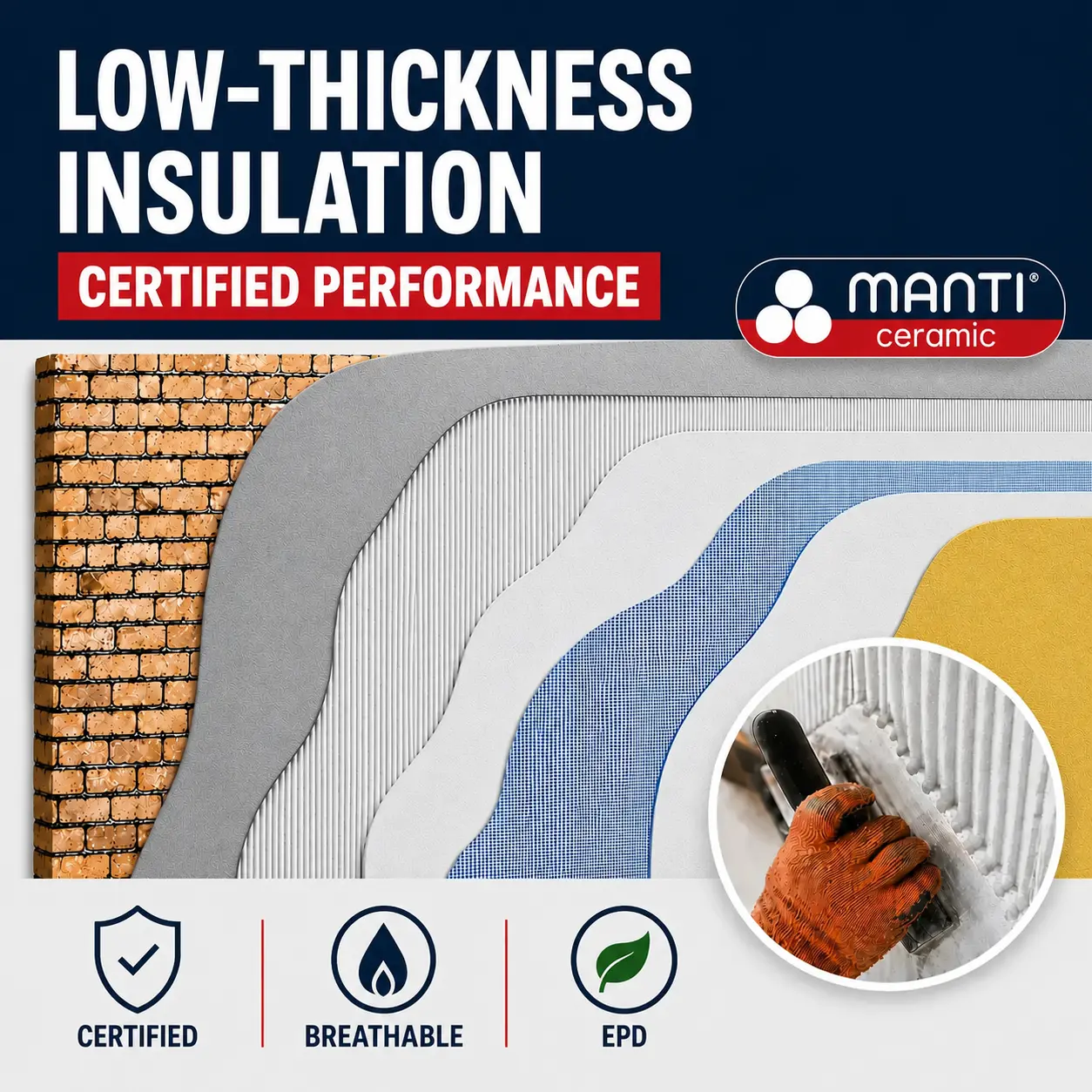
Manti Ceramic is a low-thickness nanotechnology insulation solution for construction, suitable for projects requiring certified performance, breathable properties and EPD-certified product documentation.
Manti Ceramic and EPD should always be assessed in relation to the specific function of the product within the building system. Treating a cold interior wall is different from working on an external façade, an industrial roof, a pillar affected by thermal bridging or a historical surface with decorative reliefs.
Manti Ceramic is available in different versions, each intended for specific applications. The High Density version is suitable for walls and building surfaces where a greater application thickness is required, while remaining within the concept of low-thickness insulation. Medium Density is suitable for vertical and horizontal surfaces, thermal bridge correction, ceilings, balconies, concrete structures and contexts where reduced thickness must be maintained.
Manti Ceramic Low Density Transparent can be evaluated for visible surfaces where it is important to preserve the appearance of the substrate. Manti Ceramic Technological M is suitable for industrial roofs and surfaces such as metal, wood, plastic, cement and concrete, where thermo-reflective and waterproofing properties are required.
Environmental documentation should always be connected to the specific product version and intended use. For this reason, in a technical project it is important to verify which EPD applies to the selected product, what data it includes and how that data should be interpreted within the construction system.
Which technical performances should support environmental documentation
An EPD provides environmental information, but the suitability of a product for a construction project also depends on its technical performance. In the case of low-thickness insulation, several data points should be considered: thermal conductivity, thermal or solar reflectance index, water vapour permeability, water resistance, fire reaction, VOC content, density, application thickness, drying times and substrate compatibility.

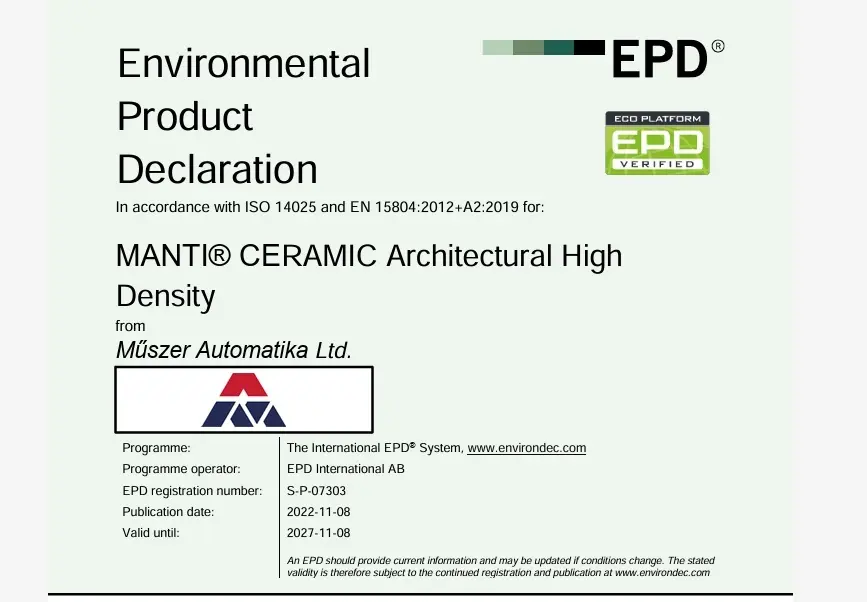
EPD certification for Manti Ceramic Architectural High Density: environmental product documentation supporting technical traceability in construction projects.
Manti Ceramic Medium Density and Manti Ceramic High Density are nanotechnology solutions for low-thickness thermal insulation. The presence of EPD for these versions can be a useful element in projects where materials with documented environmental information are valued.
In practice, the designer should assess three levels of information together:
- technical performance of the product;
- available environmental documentation;
- suitability of the application system for the substrate and building.
This approach avoids decisions based only on a label or a generic description. In construction, the effectiveness of an insulation product always depends on the correct relationship between material, surface, thickness, application cycle and project objective.
Where Manti Ceramic can be suitable in construction
Manti Ceramic can be suitable for energy retrofits, new buildings, indoor comfort improvement, thermal bridge correction and insulation of surfaces where available space is limited.
In residential buildings, it can be used on walls, ceilings and rooms with comfort issues. It is also suitable for areas with surface condensation and critical points where localised heat losses occur.
It can also be useful when a less invasive intervention is required, compatible with existing geometries and faster to apply compared to high-thickness systems. In historical buildings or façades with complex architectural details, it can be considered when mouldings, cornices, reliefs or architectural constraints make traditional panels difficult to install.
Manti Ceramic can also be applied to construction details such as window reveals, pillars, wall-floor junctions, balcony undersides, ceilings and interior surfaces with complex geometries. Its low thickness allows work on points where insulation continuity is difficult to achieve with conventional solutions.
FAQ about Manti Ceramic and EPD
What is an EPD?
An EPD, or Environmental Product Declaration, is a document that communicates quantified environmental information about a product, based on defined calculation rules and product categories.
Does Manti Ceramic have EPD documentation?
Yes. Manti Ceramic High Density and Manti Ceramic Medium Density are EPD certified. The certifications are published on www.manti-ceramic.com and on the manufacturer’s website, providing verifiable environmental product documentation for building and energy retrofit projects.
Does an EPD prove that a product is the best insulation material?
No. EPD provides environmental information, but the choice of an insulation product should also consider thermal performance, substrate, thickness, fire reaction, permeability, application method and real conditions of use. Manti Ceramic is supported by technical documentation for these parameters.
Why can Manti Ceramic be useful in energy retrofits?
It allows low-thickness intervention on surfaces where traditional systems can be invasive, such as walls, ceilings, pillars, balconies and complex façades.
Can Manti Ceramic help reduce condensation and mould?
On cold walls and thermal bridges, an insulation treatment can improve surface temperature and help reduce condensation and mould conditions, while ventilation, indoor humidity and substrate condition must also be assessed.
Conclusion
Savenergy.it proposes solutions for low-thickness nanotechnology thermal insulation and surface rehabilitation in construction, with technical support in selecting the most suitable product for each application context.
For information about Manti Ceramic, technical documentation, EPD and possible applications in construction projects, write to info@manti-ceramic.com.
Ing. Elena Galeotti
May 4, 2026
Why Manti Ceramic Is Suitable for Historic Building Insulation: The Case of Religious Buildings
/0 Comments/in News/by Elena GaleottiWhy Manti Ceramic Is Suitable for Historic Building Insulation: The Case of Religious Buildings
Opening summary
Manti Ceramic for Historic buildings is a relevant topic whenever insulation must be applied on valuable masonry with reduced thickness and careful attention to hygrothermal behavior. This is especially important in historic religious buildings, which are among the most common examples of heritage construction in Italy. In a hygrothermal assessment carried out by CMR Center Materials Research, the Manti Ceramic system showed a gradual reduction in hygrometric values in the treated sample, both internally and externally.
Contents
- Why moisture is a critical issue in historic buildings
- What the CMR test says about Manti Ceramic
- Why this result is especially useful in religious buildings
- When low-thickness insulation is suitable for historic masonry
- What to assess before application on protected buildings
- Which Manti Ceramic versions are suitable for historic buildings
Why moisture is a critical issue in historic buildings

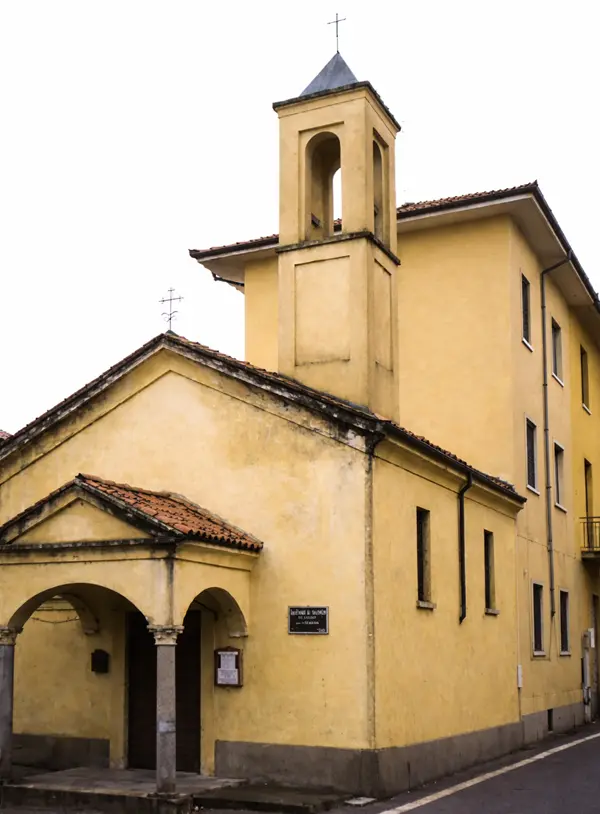
Historic place of worship: an example of a building where low thickness can be useful for working on the walls without altering the architectural balance.
When discussing Manti Ceramic for the insulation of Historic buildings, the starting point is a practical issue: in heritage construction, heat loss is not the only concern. It is also essential to consider how the masonry reacts to moisture and to changing hygrothermal conditions.
Historic buildings often feature thick walls, irregular surfaces, architectural details that must be preserved, and strong limitations on the thickness that can be added. Religious buildings are one of the clearest examples. Churches, monasteries, chapels, parish buildings and related spaces are a significant part of the historic built heritage and often include large interior volumes, intermittent heating use and cold surfaces.
When these conditions occur together, managing surface moisture and masonry behavior becomes a technical priority. For this reason, when evaluating an insulation system, it is useful to consider not only thermal performance but also hygrometric behavior.
What the CMR test says about Manti Ceramic and how it works on historic buildings
To better understand Manti Ceramic for thermal insulation of Historic buildings, it is useful to refer to the hygrothermal assessment carried out by CMR Center Materials Research. The test was performed on four sample buildings, all with the same solar exposure and comparable envelope conditions:
- one without insulation
- one insulated with Manti Ceramic on internal surfaces only
- one insulated with Manti Ceramic on both internal and external surfaces
- one insulated externally with 6 cm EPS
Sensors recorded air temperature, relative humidity and surface temperature.
The most relevant result concerns internal relative humidity. According to the CMR test, the buildings treated with Manti Ceramic, both in the internal-only solution and in the in-and-out solution, showed better moisture dissipation than the EPS sample. The hygrometric values in the masonry also showed a slow and progressive decrease over time.
This aspect is particularly relevant when dealing with historic masonry, where moisture management is often as important as thermal correction.
Why this result is especially useful in religious buildings
The topic of Manti Ceramic for Historic buildings becomes even more concrete when religious buildings are considered as a typical case of historic heritage. In these buildings, the challenge is rarely just “to insulate”. The real issue is how to intervene without altering geometries, decorative elements, reveals, jambs, large surfaces and often delicate construction details.
In addition, intermittent heating systems and great internal heights can increase surface imbalances and hygrometric criticalities. For this reason, a low-thickness insulation system that is associated with a progressive reduction in hygrometric values may be particularly useful in helping to preserve the building.
This is one of the reasons why Manti Ceramic may be suitable for many historic buildings, and especially for religious buildings: not only because of its low thickness, but also because the measured behavior suggests a favorable interaction with internal relative humidity within the envelope. This remains a technical aspect to be assessed case by case, not an automatic solution valid for every building.
When low-thickness insulation is suitable for historic masonry
Within the topic of Manti Ceramic for Historic buildings, low thickness remains a decisive criterion. In historic construction, it is not always possible to use traditional systems that require several centimeters of material and involve modifications to cornices, moldings, connections, thresholds, reveals or decorated surfaces.
A low-thickness system can therefore be useful when the intervention must remain more compatible with the existing geometry and have a lower visual and physical impact on the building fabric. Manti Ceramic, in its semi-liquid Media Density version, can be applied at around 1–2 mm by roller or spray and may be particularly useful on thermal bridges created by decorative elements, reliefs and complex geometries.
This can apply to valuable internal walls, surfaces affected by thermal bridges, masonry with reduced space availability, rooms with architectural details that must be preserved, and religious buildings where the conservation of proportions and surfaces is part of the building’s value.
What to assess before application of Manti Ceramic on protected, historic buildings
Before any choice is made, it is important to assess the type of substrate, the possible presence of salts, rising damp, ventilation conditions, the actual use of the building, existing finishes and conservation restrictions.
It is equally important to distinguish between different technical goals:
- thermal insulation
- thermal bridge correction
- reduction of surface condensation
- remediation of masonry affected by other causes of deterioration
Savenergy.it offers low-thickness thermal insulation solutions designed to balance performance, substrate compatibility and attention to masonry behavior over time.
Which Manti Ceramic versions are suitable for historic buildings
Manti Ceramic High Density
Manti Ceramic High Density is suitable where a thicker low-thickness system is needed on masonry surfaces, both internal and external.
Main technical data:
- certified thermal conductivity: λd = 0.0010 W/mK (view the data sheet for Technical recommendations for Application Thermal Calculations)
- recommended thickness: 2–10 mm
- SRI: 109
- fire reaction: Euroclass A2 s1 d0
Manti Ceramic Media Density
Manti Ceramic Media Density is especially suitable where reduced thickness is essential, such as on decorative details, thermal bridges and complex surfaces.
Main technical data:
- certified thermal conductivity: λd = 0.0010 W/mK
- recommended thickness: 1–2 mm
- SRI: 107
- fire reaction: Euroclass A2 s1 d0
In historic contexts, the result highlighted by the CMR report regarding the reduction of hygrometric values can be considered a useful technical element during the evaluation phase.
FAQ about Manti Ceramic for the insulation of Historic Buildings
Is Manti Ceramic suitable for historic buildings?
It is suitable thanks to low thickness, compatibility with valuable surfaces and attention to the hygrothermal behavior of masonry are required.
Why are religious buildings an important case when discussing Manti Ceramic Historic buildings?
Because many religious buildings belong to the historic built heritage and often have thick masonry, delicate surfaces, large interior volumes and strict thickness limitations.
When is low-thickness insulation useful on historic masonry?
It is particularly useful where traditional insulation would interfere with decorative details, proportions, reveals, thresholds or valuable internal and external finishes.
Can Manti Ceramic help in buildings with moisture-related issues?
It can be useful in cases where the interaction between insulation and masonry moisture behavior is a relevant factor. This should always be verified according to the specific building conditions.
Conclusion
To assess whether Manti Ceramic is suitable for a historic building, Savenergy.it provides technical support to analyze masonry type, thickness limitations and application context.
For information: info@manti-ceramic.com
To explore more applications and practical case studies, you can visit our LinkedIn https://www.linkedin.com/company/savenergy-it-srl-holding/
Eng. Elena Galeotti
April 19, 2026
Thermal insulation 8 mm: on Lake Como –36% energy consumption without altering the aesthetics
/0 Comments/in News/by Elena GaleottiThermal insulation 8 mm: on Lake Como –36% energy consumption without altering the aesthetics
Summary: In 2019, on a villa overlooking Lake Como, we carried out a thermal insulation 8 mm intervention capable of eliminating thermal bridges, preserving the original aesthetics and reducing energy consumption by 36%. A complex technical challenge solved through a certified nanotechnological system and a carefully executed installation.
Quick index
- The project context: aesthetic constraints and thermal issues
- Why choose thermal insulation 8 mm
- The complete Manti Ceramic system applied in Menaggio
- Measurable results over time
- Certified λ value and design based on real data
- The importance of proper installation
- Technical FAQ for designers and contractors
Villa on Lake Como with thermal insulation 8 mm intervention on the façade

The project context: aesthetic constraints and thermal issues
In 2019 we worked on a villa in Menaggio, overlooking Lake Como, with a clear request from the project architect: drastically improve the building’s energy performance without altering its architectural appearance.
The presence of:
- traditional façades
- exposed stone surfaces
- pronounced thermal bridges around window reveals
made the intervention particularly delicate.
A traditional high-thickness external insulation system would have required significant structural modifications, changes to the architectural proportions and invasive work on thresholds, window sills and metal flashings (as well as potentially creating unhealthy indoor conditions such as mold and fire risks when synthetic insulation is used).
A different approach was therefore required.
Why choose thermal insulation 8 mm with Manti Ceramic
The objective was to achieve a truly high-performance thermal insulation 8 mm, capable not simply of slowing heat transfer but significantly reducing it through a high thermal reflectance system.
Unlike traditional insulation systems:
- it does not require thicknesses of 8–15 cm
- it does not alter architectural lines
- it does not create critical issues in construction details
- it allows precise correction of thermal bridges
Furthermore, it enables a tailor-made intervention, calibrated point by point across the building envelope.
The complete system applied in Menaggio
The intervention was carried out using an integrated Manti Ceramic system:
- 8 mm of Manti Ceramic High Density on the external façades
- Manti Ceramic Medium Density on thermal bridges (window reveals, structural junctions, under balconies)
- Transparent Low Density on exposed stone surfaces
This approach made it possible to intervene precisely, eliminating thermal discontinuities without compromising the original aesthetic appearance.
Thermal insulation 8 mm and measurable results over time
Today, several years later, the installed thermal insulation 8 mm system continues to ensure:
✓ Completely transformed living comfort
✓ More stable and drier indoor environments
✓ Average annual energy consumption reduction of 36%
The measured average reduction of –36% energy consumption is a result that would not have been achievable with either traditional thick insulation systems or lower-quality nanotechnological coatings.
Certified λ value: designing with real data

A crucial aspect for designers is the availability of objective and verifiable data.
Manti Ceramic is the only nanotechnological thermal insulation with a thermal conductivity value (λ) certified by an accredited third-party body:
0.001 W/mK for Medium Density
0.002 W/mK for High Density
This means:
- energy calculations based on verifiable parameters
- greater reliability in technical reports
- the possibility of formal certifications supported by official documentation
In a market where many solutions rely mainly on commercial claims, certification represents a fundamental differentiating factor.
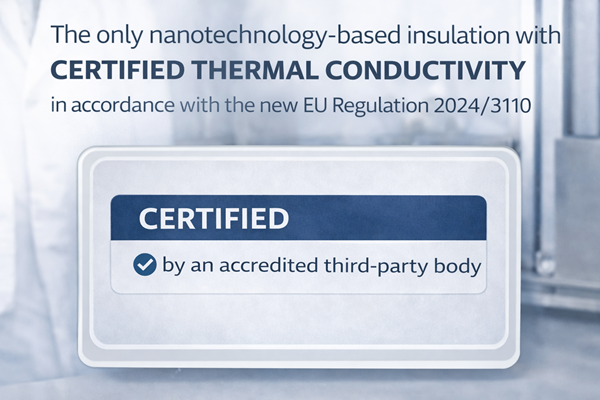
Certified λ thermal conductivity from an accredited body for the thermal insulation 8 mm system.
The importance of correct application for the thermal insulation 8 mm Manti Ceramic system
An often underestimated factor concerns the workability of the material.
During the intervention on Lake Como, both installers and the site manager highlighted:
- smooth and easy trowel application
- absence of significant material waste
- simplicity in correcting details
A high-performance material that is difficult to apply often leads to mistakes, cracks and reduced durability.
On the contrary, easy application improves the final quality of the work and reduces the risk of long-term problems.
High performance, ease of installation and measurable results: this is what distinguishes an advanced technology from a simple thin coating.
FAQ – Frequently asked questions for technicians
Can an 8 mm thermal insulation replace a traditional external insulation system?
Absolutely yes. Manti Ceramic does not work by thermal resistance but by blocking the thermal wave, acting as a thermal shield.
Is it suitable for historic buildings?
Yes, especially thanks to its ability to reduce wall moisture levels and eliminate thermal bridges around decorative elements, cornices and façade details using the liquid version. It is highly appreciated by heritage protection authorities.
Can it be officially certified for energy calculations?
Yes, thanks to the third-party certified λ value.
Conclusions
The Lake Como case demonstrates that it is possible to achieve significant energy improvement with thermal insulation 8 mm, without altering the aesthetics and without invasive structural interventions.
When design, materials and installation work in synergy, the result is not just theoretical improvement but a concrete and measurable benefit over time.
To receive the complete technical data sheet or discuss a specific project, you can contact us at:
We also invite you to visit our linkedin page https://www.linkedin.com/company/savenergy-it-srl-holding/
Eng. Elena Galeotti
Nanotechnological Certified Insulation Products: the New Manti Ceramic DoPC under EU Regulation 2024/3110
/0 Comments/in News/by Elena GaleottiNanotechnological Certified Insulation Products: the New Manti Ceramic DoPC under EU Regulation 2024/3110
✅ Abstract this article deals with innovations in the nanotechnological certified insulation products.
With the entry into force of EU Regulation 2024/3110, construction material certifications have taken on a central role in protecting designers and construction supervisors. In this article, we explain what it truly means today to choose nanotechnological certified insulation products, focusing on the new Manti Ceramic DoPC and the TÜV-certified thermal conductivity values λ (0.001 W/mK and 0.002 W/mK). This regulatory update strengthens transparency, technical responsibility, and documentary reliability in the thin-layer insulation sector.
📌 INDEX
- EU Regulation 2024/3110 and the new DoPC
- Why nanotechnological certified insulation products are essential today
- Certified thermal conductivity values of Manti Ceramic
- The importance of accredited third-party bodies (TÜV)
- Implications for designers and construction managers
- 15-year extended warranty
- Conclusions
EU Regulation 2024/3110 and Nanotechnological Certified Insulation Products
In the thin-layer thermal insulation sector, it is no longer enough to declare high performance. Performance must be proven.
With EU Regulation 2024/3110, the certification system for construction materials has been significantly strengthened, introducing:
- Greater data traceability
- Mandatory verifiable performance
- Direct manufacturer responsibility
- Alignment between laboratory testing and declared values
Within this updated regulatory framework, choosing nanotechnological certified insulation materials is no longer optional — it is a professional necessity.
Manti Ceramic has fully renewed its Declarations of Performance and Conformity (DoPC). The new tests have been conducted by TÜV, one of the most authoritative internationally accredited certification bodies.
This means that Manti Ceramic products are not simply an innovative micro-coatings, but only ones truly nanotechnological certified insulation products available on the European market.
Certified Thermal Conductivity of Manti Ceramic Nanotechnological Certified Insulation Products
The new certifications have demonstrated outstanding results.
🔹 Manti Ceramic High Density
- λ = 0.001 W/mK for thicknesses from 1 to 3 mm
- λ = 0.002 W/mK (rounded value) for thicknesses from 4 to 10 mm
🔹 Manti Ceramic Medium Density
-
λ = 0.001 W/mK
These values are:
✔ Measured
✔ Verified
✔ Certified by an accredited third party
They are not theoretical estimates or marketing claims.
To date, Manti Ceramic products represent the only nanotechnological certified insulation products in Europe with lambda values tested and documented under the new regulatory framework.

Why Nanotechnological Certified Insulation Products Are Crucial for Designers
For engineers, energy consultants, and construction supervisors, the difference between a declared value and a certified value is decisive.
Using nanotechnological certified insulation products allows professionals to:
- Use reliable data in U-value calculations
- Prepare compliant technical reports
- Reduce professional liability risks
- Increase safety in energy performance certifications
Moreover, in high thermal reflectance materials designed to block thermal wave transmission, traditional testing methods (suitable for conventional insulating panels) are not appropriate.
The dedicated tests performed on Manti Ceramic evaluate product behavior according to:
- Applied thickness
- Physical insulation principle
- Thermal reflectance
Thus ensuring a scientifically consistent approach.
Transparency, Certification and Extended Warranty

The update of the DoPC has been accompanied by another distinctive element:
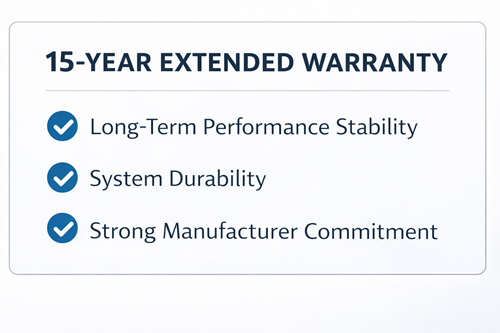
👉 15-year extended warranty
A record in the thin-layer thermal insulation sector.
This demonstrates:
- High performance stability
- Long-term durability
- Manufacturer confidence in its technology
Certification and warranty must be consistent: only structurally reliable nanotechnological certified insulation coatings can offer both.
Conclusions
The nanotechnology insulation market is rapidly growing. However, not all products provide:
- Updated DoPC compliant with EU Regulation 2024/3110
- Thermal conductivity certifications issued by accredited bodies
- Measured and documented lambda values
For this reason, choosing nanotechnological certified insulation coatings such as Manti Ceramic means choosing:
- Technical transparency
- Professional protection
- Documentary reliability
- Technological leadership
📩 To receive the updated DoPC and technical design support, please contact:
Follow our Linkedin Page: https://www.linkedin.com/company/savenergy-it-srl-holding/
Thermal Insulation Application Time: How It Impacts Costs and Insulation Decisions
/0 Comments/in News/by Elena GaleottiThermal Insulation Application Time: How It Impacts Costs and Insulation Decisions
What You Will Learn
When evaluating a thermal insulation system, most professionals focus on performance values and material thickness. However, thermal insulation application time plays a decisive role in project costs, site management, and overall investment efficiency.
Today, innovative solutions such as Manti Ceramic nanotechnology micro-insulation coating significantly reduce thermal insulation application time compared to traditional panel-based systems.
Why Thermal Insulation Application Time Is a Decisive Factor
Thermal insulation application time affects much more than just how long a construction site remains active. It directly influences:
- Labor costs
- Scaffolding rental duration
- Public space occupation permits
- Disruption for occupants
- Exposure to weather risks
The longer the thermal insulation application time, the higher the likelihood of delays, unexpected expenses, and operational inefficiencies.
In urban environments, logistical and administrative procedures can further extend timelines, increasing indirect costs.
For this reason, thermal insulation application time should be a primary criterion when selecting an insulation solution.
Complexity and high cost of applying traditional panel-based insulation systems
A traditional external thermal insulation composite system (ETICS) typically requires:
- Scaffolding installation
- Surface preparation
- Adhesive bonding of insulation panels
- Mechanical anchoring
- Reinforced base coat application
- Finishing layer
Additional related works are often necessary, including:
- Replacement of window sills
- Adjustment of downpipes and flashings
- Relocation of external installations
- Other structural modifications
As a result, the application time of the isulation system can extend over several weeks, particularly in multi-story residential buildings.
How Thickness Increases Thermal Insulation Application Time
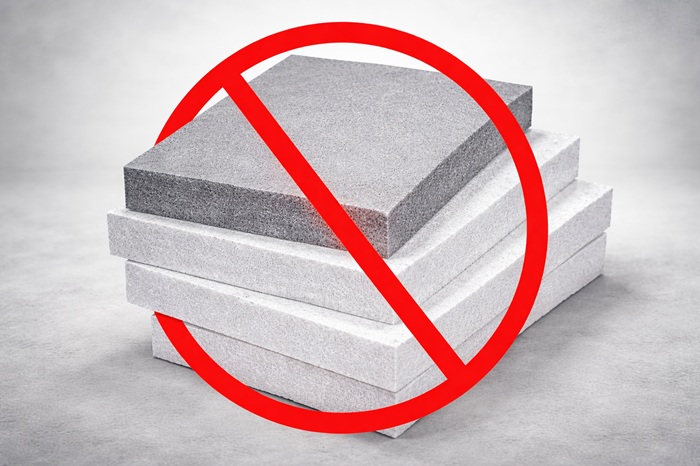
Traditional insulation panels usually range from 8 to 16 cm in thickness.
This thickness often requires:
- Structural adjustments
- Extended drying times between layers
- Additional finishing work
- Increased site complexity
Therefore, when analyzing the installation time of the thermal insulation system, it is essential to consider not only the installation of the insulating material but also the entire system of connected structural interventions.
How to Reduce Insulation Application Time with Manti Ceramic
Unlike panel-based systems, Manti Ceramic microcoating offers a radically different approach that significantly reduces the application time of the thermal isulation system.
Key advantages include:
- Trowel application similar to a reinforced skim coat (High Density version)
- Spray application option (Medium Density version)
- No insulation panels required
- No mechanical anchors
- No need to modify window sills or metal flashings

Its ultra-thin thickness (1–10 mm) eliminates invasive structural work and allows for faster and more efficient site management.
Because there are no panels, many critical issues related to structural thermal bridges and mechanical fixings are avoided.
This streamlined system dramatically reduces the application time of the thermal insulation system while maintaining high technical performance.
Conclusion: Reducing complexity and time for the Application of an insulating system Improves Efficiency
Evaluating insulation systems based on application time allows for a more comprehensive and strategic project assessment.
Shorter application time results in:
- Lower indirect costs
- Reduced exposure to weather conditions
- Minimal disruption for residents and businesses
- Faster return on investment
Thanks to nanotechnology and minimal thickness, Manti Ceramic microcoating represents an advanced solution for professionals seeking to reduce the application time of the thermal insualtion system while improving overall project efficiency.
Contact Us
For further information, please contact: info@manti-ceramic.com
Follow our Linkedin Page: https://www.linkedin.com/company/savenergy-it-srl-holding/
When Traditional Thermal Insulation Is Not Possible: Alternative Thermal Insulation System Solutions
/0 Comments/in News/by Elena GaleottiWhen Traditional Thermal Insulation Is Not Possible: Alternative Thermal Insulation System Solutions
What This Article Covers
Traditional high-thickness thermal insulation systems are widely used to improve building energy efficiency. However, they are not always feasible due to architectural constraints, limited space, building regulations or heritage protection requirements. In these cases, it is essential to consider an Alternative Thermal Insulation System.
Article Index
- When Traditional Thermal Insulation Is Not Applicable
- Alternative Thermal Insulation System: The Role of Low Thickness
- Why the Manti Ceramic Alternative Thermal Insulation Product Is an Effective Solution
- Where to Use an Alternative Thermal Insulation System
- Conclusions and Advantages of Nanotechnology-Based Solutions
Historic buildings, façades facing public streets, property boundaries or internal renovations often make traditional insulation systems impractical or even prohibited. In these cases, it is essential to consider an Alternative Thermal Insulation product capable of delivering energy efficiency without invasive construction work.
When traditional insulation cannot be applied
There are many situations in which external thermal insulation systems cannot be installed. Heritage-protected buildings often prohibit increases in façade thickness, while urban planning regulations may restrict invasive modifications in city centers or residential buildings.
In addition, traditional insulation systems frequently require complex structural interventions such as replacing window sills, modifying gutters, relocating downpipes or shutters, significantly increasing costs and installation time.

The role of low-thickness alternative insulation systems
When traditional insulation is not possible, low-thickness technologies provide an effective solution. An Alternative Thermal Insulation System does not rely solely on thickness to reduce heat transfer, but instead uses advanced principles such as thermal reflectance and heat flow inhibition.
Thanks to nanotechnology, it is now possible to achieve high insulation performance with only a few millimeters of material, preserving building aesthetics and avoiding invasive works. This represents a true evolution of the thermal insulation concept.
Why Manti Ceramic is an effective Alternative Thermal Insulation System
Unlike traditional insulation systems that simply slow heat transfer through thickness, Manti Ceramic (1–10 mm) acts as a thermal shield, reflecting a significant portion of heat rather than only delaying it.
This results in balanced thermal performance in both winter and summer. The reduced thickness also allows effective treatment of critical thermal bridges such as window reveals, beams, slabs and balconies, areas often inadequately addressed by conventional systems.
Where to use Manti Ceramic alternative thermal insulation systems
Manti Ceramic low-thickness solutions (High Density and Medium Density) are particularly suitable for:
- historic and protected buildings
- façades facing public streets or property boundaries
- internal insulation interventions
- thermal bridge correction
- integration or completion of existing insulation systems
In all these contexts, Manti Ceramic improves energy efficiency without compromising space, aesthetics or building functionality.
Conclusions
Thermal insulation remains a key strategy for energy savings, but traditional systems are not always applicable. Understanding and adopting an Alternative Thermal Insulation product based on nanotechnology makes it possible to achieve effective insulation even in the most complex building scenarios.
Today, buildings can be insulated more efficiently, with less thickness and fewer invasive works, achieving greater comfort, energy savings and long-term durability.
👉 Contact us
For more information about Manti Ceramic Alternative Thermal Insulation System solutions, contact us at info@manti-ceramic.com.
Follow our Linkedin Page: https://www.linkedin.com/company/savenergy-it-srl-holding/
How Internal Thermal Insulation Works: As Effective as External Solutions
/0 Comments/in News/by Elena GaleottiHow Internal thermal Insulation Works: As Effective as External Solutions
When internal thermal insulation changes the rules of the game
✅ What you’ll read:
This article explains how internal insulation works and shows how, thanks to nanotechnology, it is now just as effective as external insulation, with significant practical advantages.
📑 Article summary:
- 🔍 Why internal insulation is often the only viable solution in listed buildings or shared properties
- 🧪 How internal insulation works: reflectivity and low conductivity deliver high performance in just a few millimetres
- 🧱 Practical advantages of internal insulation with Manti Ceramic:
- no scaffolding
- no demolition
- possible to insulate only where needed
- 🔁 Same thermal performance inside or outside: Manti Ceramic blocks thermal waves in both directions
- 🏛️ Ideal for historic or urban buildings where external insulation is not possible
Internal thermal insulation: a valid alternative
In the construction industry, thermal insulation is one of the most common and debated topics. For many years, external insulation was considered the only truly effective solution. But today, thanks to advanced materials, we know exactly how thermal insulationg produtcts works — and why it is just as effective, and often more practical and economical.
Why choose internal insulation?
Many buildings cannot be insulated externally due to:
- architectural restrictions (e.g. listed façades or historic buildings)
- condominium regulations or shared spaces
- boundary constraints with neighbouring properties
In these cases, the only viable option is to insulate from the inside — as long as high-performance materials are used, and not just basic thermal paints.
How internal thermal insulation works: resistance + reflectivity
The real innovation in recent years is the development of nanotechnology-based, ultra-thin insulation materials, such as ceramic microsphere coatings.
These products do more than just slow down heat transfer (resistance): they also reflect radiant energy thanks to their multilayer structure and spherical particle geometry.
Certified testing has shown that just 8 mm of Manti Ceramic can achieve thermal performance comparable to 12 cm of EPS panels.
In short, how internal insulation works is based on three key factors:
- extremely low thermal conductivity (λ as low as 0.001 W/mK)
- high reflectivity
- continuous, seamless application even on complex surfaces

Why internal insulation makes sense
Beyond thermal performance, internal thermal insulation with products like Manti Ceramic offers clear practical advantages:
- no scaffolding or external construction required
- quick installation, no demolition or disruption for occupants
- maximum flexibility: insulate only where needed, optimising time and cost
For example, in a two-storey home with insulation problems only on the upper floor, Manti Ceramic can be applied just to the walls and ceilings of that level — avoiding unnecessary work and saving significantly.
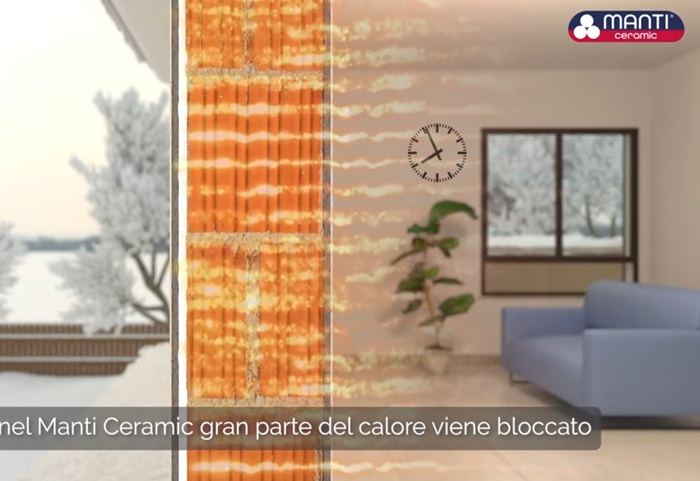
🔍 Moreover, Manti Ceramic performs exactly the same whether applied inside or outside, as its effectiveness lies in its ability to block thermal waves: it retains indoor heating in winter and reflects solar heat in summer. For this reason, its position within the wall structure is irrelevant in terms of thermal performance.
How Internal thermal insulation works: the right solution for historic and urban buildings
More and more professionals are opting for internal insulation in city apartments, heritage buildings, or shared structures where external solutions are not feasible or cost-effective.
With the right technology, it is now possible to achieve better results than with traditional external insulation systems — preserving the building’s appearance, reducing costs, and gaining additional benefits such as breathability, mould resistance, and Euroclass A2 fire rating.
📩 Want to learn more about how internal insulation works and get expert advice? Write to us at info@manti-ceramic.com
Follo our linkedin page: https://www.linkedin.com/company/savenergy-it-srl-holding/
Eliminating Thermal Bridges with a Low Thickness Thermal Coating: the Innovative Manti Ceramic Solution
/0 Comments/in News/by Elena GaleottiEliminating Thermal Bridges with a Low Thickness Thermal Coating: the Innovative Manti Ceramic Solution
Summary
Thermal bridges are one of the main causes of energy inefficiency, building envelope deterioration, and mold formation.
In this article, we analyze how thermal bridges form, the damage they cause, and why Manti Ceramic is the ideal solution thanks to its low thickness thermal coating, easy to apply and durable over time.
📑 Contents
- What thermal bridges are and how they form
- The risks of ignoring or mismanaging them
- Why traditional insulation systems cannot fully eliminate them
- Manti Ceramic: the low thickness thermal coating that neutralizes thermal bridges
🔍 What Is a Thermal Bridge and Why It Is a Problem
A thermal bridge is a discontinuity in the building envelope where heat flows more easily. It forms when:
- There is a change in materials (e.g. reinforced concrete vs masonry)
- Insulation thickness is not continuous
- Geometric interruptions occur (corners, beams, balconies, junctions)
In these areas, heat flow is significantly higher than in the rest of the wall, creating cold internal surfaces that can:
- Promote condensation and mold growth
- Reduce indoor comfort
- Increase heating and cooling energy consumption
- Decrease the overall effectiveness of insulation

⚠️ Problems Caused by Thermal Bridges When a Low Thickness Thermal Coating Is Not Used
If not properly treated, thermal bridges cause progressive and costly damage:
- Black mold on interior walls, especially near corners, beams, and columns
- Paint staining and detachment
- Corrosion of steel reinforcement (in the presence of persistent condensation in concrete)
- Thermal discomfort in both winter and summer
- Reduction of the building’s energy rating
Many external insulation systems using traditional solutions fail to completely eliminate thermal bridges, especially in critical areas such as:
- Window reveals
- Balcony undersides
- Internal and external corners
- Geometric discontinuities
👉 These are typical examples of thermal bridges that can be eliminated with a low thickness thermal coating like Manti Ceramic.
🧱 The Limits of Traditional Insulation Systems in Managing Thermal Bridges
Traditional insulation systems such as EPS, mineral wool, or polyurethane show clear limitations in construction details:
- Difficult installation in critical areas
- Excessive thickness that prevents insulation of beams or window reveals
- Inability to ensure real continuity between vertical and horizontal surfaces
- Risk of water infiltration if not perfectly sealed
The result?
The thermal bridge remains — and so do the problems.
✅ Manti Ceramic: the Low Thickness Thermal Coating That Solves Thermal Bridges
The definitive solution to eliminate thermal bridges in a simple, fast, and long-lasting way is Manti Ceramic, a low thickness thermal coating based on ceramic nanotechnology.
🌟 Key Features
- Reduced thickness: from 1 to 10 mm
- Spray or roller application, even on curved or irregular surfaces
- Very high solar reflectance (SRI > 100)
- Extremely low thermal conductivity: blocks heat transfer
- Excellent adhesion to concrete, plaster, brick, metal, and wood
- Waterproof yet breathable
- Non-toxic, fire-resistant, and durable
Thanks to its direct application and flexibility, Manti Ceramic follows the real geometry of the building, sealing even those areas where traditional panels cannot be installed.
🧠 Where to Use a Low Thickness Thermal Coating to Eliminate Thermal Bridges
- Window reveals
- Through-window sills
- Vertical and recessed corners
- Curved or complex surfaces (decorations, capitals, etc.)
- Balcony soffits
- Junctions between walls and slabs
- Under-balconies, terraces, and eaves
With a targeted application of Manti Ceramic, either combined with or replacing traditional insulation systems, it is possible to truly eliminate every thermal bridge without invasive interventions.
🏁 Conclusion
A low thickness thermal coating is the most modern and functional response to the problem of thermal bridges.
Manti Ceramic allows every construction detail to be insulated, even where traditional systems fail, providing a continuous, thin, effective, and durable thermal barrier.
📩 Do you have a project with thermal bridges that are difficult to solve?
Contact us at info@manti-ceramic.com for technical consultancy.
Follow our linkedin: https://www.linkedin.com/company/savenergy-it-srl-holding/